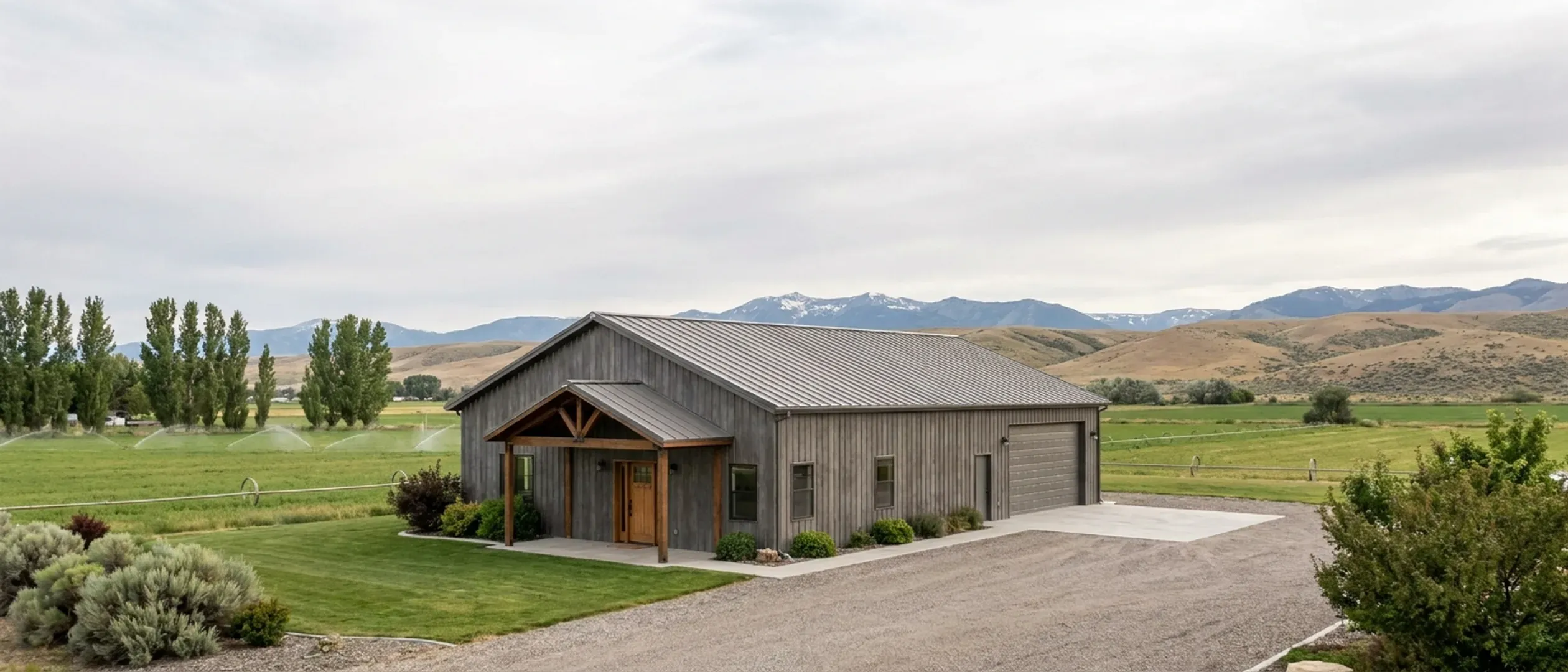
Barndominium vs House Cost in Idaho: Where the Money Actually Differs
"Barndominiums are cheaper than houses" is repeated everywhere and measured almost nowhere. What can be measured is where a house's money goes. NAHB's national survey of builders breaks the construction cost of a new home into stages, and the Census Bureau publishes what finished houses cost per square foot in the West region, which includes Idaho, and what new Idaho homes were valued at on their building permits. Put together, they show which lines a steel or pole barn shell can change: the frame, the roof structure and the exterior walls. They also show which lines it cannot: the plumbing, wiring, heating, kitchen, septic, well and power line that a barndominium needs exactly as much as any other house. This guide works through both, with every figure attributed.
Figures below are industry data from cited third-party sources, not a quote from Idaho Barndominium Builders. Every project is priced individually.
Bottom Line Up Front
- NAHB's 2024 survey puts framing at 16.6% of a new home's construction cost and exterior finishes at 13.4%. Those are the lines a steel or pole barn shell changes; the rest of the budget is needed either way.
- Interior finishes (24.1%) and the plumbing, electrical and HVAC rough-ins (19.2%) are each larger than framing in NAHB's survey, and a finished barndominium needs all of them.
- The fair comparison is finish for finish against the Census Bureau's 2025 West figure for contractor-built houses on the owner's land: a median of $176.87 per square foot, land excluded.
Published cost figures
Third-party and government figures, each with its source. None of them is a quote, and none of them is ours.
| Measure | Range | Source |
|---|---|---|
| Contractor-built houses on the owner's land, West region, started in 2025: median to average contract price (land excluded) | $177–$214 per sq ft | U.S. Census Bureau, Characteristics of New Housing 2025, Median and Average Contract Price per Square Foot of New Contractor-Built Single-Family Houses Started: West median $176.87, average $213.85 (read 27 Sep 2026) — https://www.census.gov/construction/chars/xls/contractpricesqft_cust.xls |
| Detached new houses sold by builders, West region, 2025: median to average sales price (lot excluded) | $212–$222 per sq ft | U.S. Census Bureau, Characteristics of New Housing 2025, Median and Average Price per Square Foot of Floor Area in Detached New Single-Family Houses Sold: West median $211.98, average $222.47 (read 27 Sep 2026) — https://www.census.gov/construction/chars/xls/soldpricesqft_cust.xls |
| Average permit valuation per new single-family home authorized in Idaho, 2025 (structure only, as declared on the permit) | $300,700 per home | U.S. Census Bureau, Building Permits Survey, annual 2025 state data: Idaho 1-unit valuation $4,242,918 thousand across 14,112 units, about $300,700 each (arithmetic; read 27 Sep 2026) — https://www.census.gov/construction/bps/xls/stateannual_202599.xls |
What actually moves the number
Framing and the roof structure
In NAHB's 2024 survey, framing including the roof is 11.6% of construction cost, trusses 3.0% and sheathing 1.5%, for a framing stage of 16.6%. A clear-span steel frame or a pole barn frame replaces these lines. How much it saves depends on the span, the snow load the roof is designed for and how many interior walls the plan still needs.
Exterior walls and roofing
NAHB puts the exterior wall finish at 5.7% of construction cost, roofing at 3.9% and windows and doors, including the garage door, at 3.7%. Metal wall and roof panels change the first two. Windows, entry doors and the big shop doors are bought either way, and a barndominium often has more door area than a house.
Everything inside
Interior finishes are 24.1% of NAHB's construction cost: insulation, drywall, trim, paint, lighting, cabinets, appliances, flooring and fixtures. The plumbing, electrical and HVAC rough-ins add 19.2%. None of it depends on whether the walls hang on steel, poles or studs.
Shop space is cheaper per foot than living space
Much of the difference people see in barndominium prices comes from how much of the building is finished. A shop or garage with a concrete floor, a steel liner and no plumbing costs far less per square foot than a bedroom or a kitchen. Compare quotes on the finished living area and the shop area separately.
What the Census numbers compare
Before comparing a barndominium with a house, pick a house figure that is measured the same way.
Contractor-built on your land
The Census Bureau's contractor-built series is the closest match to a barndominium: a general contractor building on land the owner already has. The Census reports a 2025 West median contract price of $176.87 per square foot and an average of $213.85, land excluded.
Built for sale by a builder
A spec house sold by a builder carries the builder's overhead, marketing and profit. The Census 2025 West figures for detached houses sold are $211.98 median and $222.47 average per square foot of floor area, lot excluded.
What Idaho permits say
The Census permit survey valued the 14,112 new single-family homes authorized in Idaho in 2025 at about $300,700 each, structure only. That average mixes every size and finish level, from starter homes to resort houses.
Steel framing is rare in the data
The Census reports that 99% of contractor-built houses completed in the West in 2025 were wood-framed and 1% steel-framed. The house figures are therefore conventional houses, which is what a barndominium should be measured against.
Where a steel or pole barn shell changes the budget
Clear spans and fewer bearing walls
A steel frame or a pole barn frame carries the roof on its columns or posts, so the inside needs fewer load-bearing walls. That can simplify framing, but it does not remove interior walls: bedrooms and bathrooms still need them.
Metal roofing and wall panels
Metal panels replace the exterior wall finish and roofing lines, which together are 9.6% of NAHB's construction cost. Insulating behind them to the energy code is an interior cost that remains.
The foundation is not optional
NAHB puts excavation, foundation, concrete, retaining walls and backfill at 10.0% of construction cost. A barndominium usually sits on a slab or on posts set in concrete, and it still needs footings designed for the site.
Kits price the shell, not the house
A kit price covers the frame and panels. Comparing a kit price with the finished cost of a conventional house is the most common reason people conclude a barndominium costs half as much.
Where the costs are the same
Plumbing, electrical and HVAC
NAHB puts plumbing at 6.3%, electrical at 6.4% and HVAC at 6.3% of construction cost. Licensed trade contractors handle plumbing, electrical and HVAC in a barndominium exactly as in any other house.
Cabinets, flooring and fixtures
Cabinets and countertops are 4.5% of NAHB's construction cost, flooring 3.6% and appliances 1.8%. The finish schedule you choose moves the budget more than the structure does.
Septic, well, power and driveway
On a rural parcel these lines are the same for any house. The health district's septic permit, the well, the line extension from the power company and the driveway are priced for the site.
Permits and inspections
Building permit fees are 1.8% of NAHB's national construction cost. Where your city or county issues building permits, it charges a barndominium the same way it charges any new house, and the electrical, plumbing and HVAC permits apply either way.
Reading this because you are weighing a build? The next step is a plan drawn for your program.
What's different about Idaho
The same residential code applies to both
Idaho exempts barns and other agricultural buildings from the building code, but under Idaho Code §39-4116 the exemption expressly excludes any space used for living, sleeping or cooking, so a barndominium is built and permitted as a house. Where a city or county issues building permits, a barndominium goes through the same review as any new house. Some rural counties do not run a residential building-permit program at all; electrical, plumbing and HVAC work still needs permits and inspections there, and zoning, septic and well rules still apply.
Site costs do not care about the frame
The septic permit, the system, the well, the power line and the driveway cost the same whether the house is a barndominium or a conventional home. Central District Health's July 2026 fee for a new septic permit is $1,070, Idaho Code §42-235 sets the IDWR drilling permit for a domestic well at $75, and Idaho Power's Rule H caps its residential line extension allowance at $3,778 per service. On acreage those lines can decide more of the budget than the frame choice.
Where you build changes more than what you build
Census permit data for 2025 put the average valuation of a new single-family home at about $216,100 in Canyon County, $310,100 in Ada County and $684,800 in Valley County. A barndominium in a high-cost county is compared with houses in that county, not with a statewide average.
Appraisal is the real difference
Rural Idaho parcels often have few recent comparable sales, and a barndominium has fewer still. Fannie Mae's Selling Guide accepts unique homes when the appraiser has adequate information for a reliable value, and it tells lenders to decide whether a property with large barns or storage areas is residential in nature. The financing guide covers what that means for the loan.
Pros and cons, honestly
Pros
- A steel or pole barn shell can reduce the framing, roofing and exterior wall lines, which are about 30% of a typical house's construction cost in NAHB's survey.
- Clear spans let a plan put a large shop and a home under one roof.
- Shop space finished as a shop costs less per foot than living space, so a barndominium can deliver more total floor area for the budget.
- The comparison can be made with published data: Census cost per square foot and Idaho permit values.
Cons
- Interior finishes and mechanical systems, about 43% of construction cost in NAHB's survey, are the same in a barndominium and a house.
- Site costs on acreage, septic, well, power and driveway, do not change with the frame.
- Appraisals can come in low where there are no comparable barndominium sales nearby.
- A kit price looks far cheaper than a house price only because it leaves most of the house out.
Is a barndominium cheaper than a house in Idaho?
What does a conventional new house cost per square foot in Idaho?
Why do barndominium prices per square foot look so low?
Does a barndominium need the same permits as a house in Idaho?
Is a barndominium harder to appraise than a house?
Does the frame change the septic, well or power cost?
Where does a barndominium save the most money?
Questions answered? Tell us what you want to build and we will put real numbers against it.
Sources
- NAHB — Cost of Constructing a Home 2024 (January 2025) — Table 1 construction cost breakdown; national averages only. Read 27 Sep 2026.
- U.S. Census Bureau — Median and Average Contract Price per Square Foot of New Contractor-Built Single-Family Houses Started (Characteristics of New Housing, 2025) — West 2025: median $176.87, average $213.85. Read 27 Sep 2026.
- U.S. Census Bureau — Median and Average Price per Square Foot of Floor Area in Detached New Single-Family Houses Sold (Characteristics of New Housing, 2025) — West 2025: median $211.98, average $222.47. Read 27 Sep 2026.
- U.S. Census Bureau — Type of Framing in New Single-Family Houses Completed: Contractor-Built (Characteristics of New Housing, 2025) — West 2025: wood 99%, steel 1%. Read 27 Sep 2026.
- U.S. Census Bureau — Building Permits Survey, annual state data 2025 — Idaho 1-unit: 14,112 units, $4,242,918 thousand. Read 27 Sep 2026.
- U.S. Census Bureau — Building Permits Survey, annual county data 2025 — Canyon, Ada and Valley counties, 1-unit. Read 27 Sep 2026.
- Fannie Mae Selling Guide — B4-1.3-05, Improvements Section of the Appraisal Report — Unique housing types; properties with outbuildings. Dated 06/04/2025, read 27 Sep 2026.
- Fannie Mae Selling Guide — B4-1.3-08, Comparable Sales — Rural properties. Dated 06/04/2025, read 27 Sep 2026.
- Central District Health — Septic Applications, Fees & Resources — New septic permit $1,070 (July 2026). Read 27 Sep 2026.
- Idaho Power — Rule H, New Service Attachments and Distribution Line Installations or Alterations (tariff) — Residential maximum allowance $3,778 per service, effective 15 March 2026. Read 27 Sep 2026.
- Idaho Code §39-4116 — local building code enforcement; agricultural buildings — Agricultural buildings exempt, but not a place of human habitation (living, sleeping or cooking). Read 27 Sep 2026.
- Idaho Code §42-235 — well construction permits — IDWR permit before construction; $75 for a domestic well. Read 27 Sep 2026.
Keep reading
The pages that answer the next question this one raises.
How Much Does a Barndominium Cost in Idaho?
Census cost per square foot, Idaho county permit values, land and site costs.
Read itBarndominium Financing in Idaho
Why the appraisal is the hurdle, and which loans fit a barndominium.
Read itSteel & Metal Building Construction
What a clear-span steel frame changes, and what it does not.
Read itPole Barn Homes
The pole barn frame as a lower-cost shell.
Read itTurnkey Builds
One price for the whole house, which is the fair comparison with a conventional home.
Read itWant a real number instead of a range?
Start the survey and tell us about your land and what you want to build. Include the county and parcel number if you have them, because in Idaho the zoning, the septic permit, the well and the power line to the site change the budget more than the building does. The survey costs nothing.