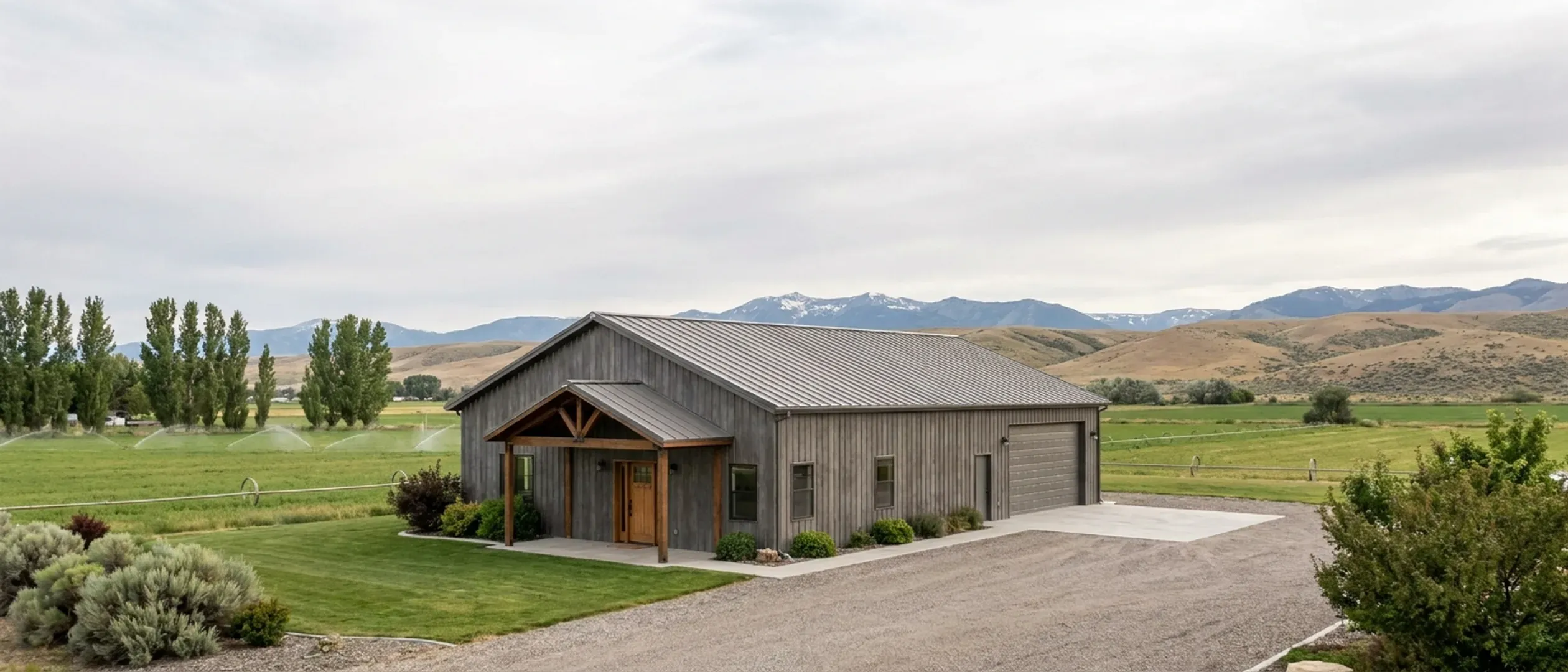
Barndominium Financing in Idaho
There is no such thing as a barndominium loan. A barndominium that will be lived in is financed as a house, usually with a construction loan that turns into a mortgage when the building is finished, and the lender's questions are the ones it asks about any new rural home: who owns the land, what the finished home will appraise for, and whether the property is a residence or a farm. This guide sets out what the published rules say about each of those, from Fannie Mae's Selling Guide and USDA's regulations, and which lenders in Idaho publish construction, land and rural home loans. We do not arrange loans, and nothing here is advice about your own finances; take the lender's own terms as the final word.
Figures on this page are cited third-party or government data, not a quote from Idaho Barndominium Builders.
Bottom Line Up Front
- Most barndominiums are financed with a construction-to-permanent loan. Under Fannie Mae's single-closing rules no single construction period may exceed 12 months and the total may not exceed 18, and the loan then converts automatically to a mortgage of up to 30 years.
- The appraisal is the usual hurdle. Fannie Mae's Selling Guide accepts unique homes when the appraiser has adequate information for a reliable value, and it allows distant or older comparable sales for rural properties when the appraiser explains why.
- Cash is common: the Census Bureau reports that 32% of contractor-built houses started in the West region in 2025 were paid for in cash, against 65% with conventional loans, 2% VA and 1% FHA.
What actually moves the number
The interest rate when you lock
Freddie Mac's weekly survey put the average 30-year fixed mortgage rate at 7.03% on 24 September 2026 and the 15-year at 6.42%, against 6.30% for the 30-year a year earlier. Construction loans are priced by each lender; Idaho Central Credit Union, for one, publishes rate-lock options of 90 to 360 days.
Whether you already own the land
Fannie Mae measures the loan-to-value of a single-closing construction loan differently depending on who holds the lot. If you are buying the lot with the loan, the value is the lesser of the purchase price, construction plus lot, and the as-completed appraisal. If you already own it, the value is the as-completed appraisal of the land and the house.
The as-completed appraisal
A construction loan is sized against what the finished home will be worth. Where there are few comparable sales, a detailed plan set, a complete specification and a clear split between living space and shop space give the appraiser more to work with.
How big the shop and the outbuildings are
Fannie Mae's Selling Guide says significant outbuildings, such as large barns or storage areas, may indicate that a property is agricultural in nature, and the lender must decide whether it is residential. A very large shop, or land that is farmed, can move a loan to an agricultural or portfolio lender.
Barndominium Loans: what actually exists
A home loan, not a barndominium loan
Lenders finance a barndominium as a single-family home when it will be lived in and appraised as a residence. The words "barndominium loan" in an advertisement usually mean a construction loan or a rural home loan with no special terms.
How new homes in the West are paid for
For contractor-built houses started in the West region in 2025, the Census Bureau reports 65% financed with conventional loans, 32% paid in cash, 2% with VA-guaranteed loans and 1% with FHA-insured loans.
The land loan often comes first
Many buyers buy the land before the building. Idaho Central Credit Union, for example, publishes land loans at up to 80% loan-to-value with 20% down that can later be rolled into a construction loan.
A kit on its own is harder to finance
A kit delivered to an empty lot is not yet a house a mortgage can be secured against. Construction lenders fund a complete plan and budget, with the kit as one line, and release money in draws as the work is inspected.
Construction Loans in Idaho
One closing, automatic conversion
In a single-closing construction-to-permanent loan, the construction loan converts to the permanent mortgage when the house is finished, under terms set at the one closing. Fannie Mae will not buy such a loan until construction is complete and the loan has converted.
The construction period
Fannie Mae allows no single construction period of more than 12 months and no total of more than 18 months, and a permanent term of up to 30 years. A lender keeping the loan itself can set other limits; Idaho Central Credit Union publishes build times of up to 20 months.
One-time or two-time close
A two-time close finances construction first and then refinances into a mortgage, with two sets of closing costs and a second qualification. A one-time close fixes the permanent terms at the start. Ask each lender which it offers and what each costs.
Documents go stale
Fannie Mae requires credit documents to be no more than four months old at the construction closing, and income, employment and credit documents no more than four months old at conversion, with a limited exception. A long build can mean requalifying at the end.
The appraisal problem, and what the rules allow
Rural homes often lack comparable sales
Fannie Mae's Selling Guide recognises that rural properties often have large lots in undeveloped areas with a shortage, or absence, of recent truly comparable sales. Sales a considerable distance away can be used if they give credible results and the appraiser explains why.
Older sales can be used
Where a rural area has minimal sales activity, the appraiser may use older comparable sales if they are the best indicator of value and the report explains why they were used.
Unique homes are eligible
Loans on unique or nontraditional housing are eligible for sale to Fannie Mae if the appraiser has adequate information to develop a reliable opinion of market value, and it is not necessary for a comparable sale to be of the same design.
What helps the appraisal
A complete plan set, a finish schedule, the living and shop areas stated separately, and any nearby barndominium or shop-house sales you know of. Agricultural or portfolio lenders that specialise in rural homes are also more used to these appraisals.
USDA Rural Development: what the rules allow
Direct loans can build a home
Under 7 CFR 3550.52, Section 502 direct loans may be used to buy, build, rehabilitate, improve or relocate an eligible dwelling. The household's adjusted income must not exceed the low-income limit for the area at loan approval, and if the house is being built, an adult member of the household must be available to make inspections and authorize progress payments.
The home must be modest
Under 7 CFR 3550.57 the property must be modest for the area and must not be designed for income-producing purposes. A barndominium with a large commercial shop is unlikely to fit.
Guaranteed loans can fund new construction
Under 7 CFR 3555.101, guaranteed loan funds may be used for the construction or purchase of a new dwelling, and for site preparation including grading, the foundation and the driveway.
Site rules that matter for a barndominium
Under 7 CFR 3555.201 the site must be in an area USDA designates as rural, of a size typical for the area, reached by a hard-surfaced or all-weather road, and served by adequate water and wastewater systems. Land or buildings used principally to produce income, and property used primarily for agriculture, are ineligible. USDA's eligibility site shows whether an address is in an eligible area.
How to Finance a Barndominium in Idaho, step by step
Settle the land first
Confirm the parcel's zoning allows a home, that a septic permit is possible and that power can reach it at a known cost. A lender will ask about all three.
Talk to a lender who finances rural homes
Ask whether it offers one-time or two-time close, its maximum build period, how it handles draws, and whether it has financed barndominiums or shop-homes before.
Bring plans and a full budget
A construction lender funds a budget, not a kit price. Include the site work, septic, well, power line, interior finishes and a contingency.
Plan for an appraisal gap
If the appraisal comes in below the budget, the difference is paid in cash or the plan changes. Knowing the likely comparable sales before you design helps avoid that.
Reading this because you are weighing a build? The next step is a plan drawn for your program.
What's different about Idaho
Farm Credit lenders serve rural Idaho
The Farm Credit System lists AgWest Farm Credit, CoBank and Idaho AgCredit as its institutions in Idaho. AgWest's country home loan page names shop-homes and barndominiums among the rural properties it finances, along with acreages without water, power or septic, and says its rural home loan specialists are familiar with appraisals and collateral that may not be typical.
Idaho credit unions publish construction and land loans
Idaho Central Credit Union's construction loan page lists one-time and two-time closing options, fixed- or variable-rate programs, build times of up to 20 months and interest-only payments during construction. Its land and lot loans list 10-, 15- and 30-year terms, 20% down, loan-to-value up to 80% and a land loan that can be rolled into the construction loan. Those are one lender's published terms, not a market rate.
Idaho Housing and Finance Association works through lenders
Idaho Housing and Finance Association offers conventional, Rural Development, FHA and VA loan options through its lending partners, with down payment and closing cost assistance, and says buyers with household income up to $170,000 a year might qualify. Its home loan page lists single-family homes, townhouses, condos and manufactured housing; it does not describe construction financing, so ask a partner lender whether a program can be used on a newly built barndominium.
Snow load and site costs belong in the loan budget
A lender funds a construction budget, and on an Idaho acreage that budget includes the septic system, the well, the power line and a roof designed for the snow load the local building official or your engineer sets for the lot. A budget that leaves those out is the usual reason a construction loan runs short before the house is finished.
Pros and cons, honestly
Pros
- A single-closing construction-to-permanent loan finances the build and the mortgage with one closing.
- Fannie Mae's rules accept unique homes and allow distant or older comparable sales in rural areas when the appraiser explains them.
- USDA's direct and guaranteed programs can fund new construction on eligible rural sites.
- Farm Credit lenders and Idaho credit unions publish construction, land and rural home loans.
Cons
- Appraisals can come in low where there are no comparable barndominium sales.
- Construction periods are limited, and a delay can mean requalifying.
- A large shop or farmed land can make a lender treat the property as agricultural.
- Rates move: Freddie Mac's 30-year average was 7.03% on 24 September 2026, up from 6.30% a year earlier.
Can you get a mortgage for a barndominium in Idaho?
What is a construction-to-permanent loan?
Why do barndominiums have trouble appraising?
Can I use a USDA loan for a barndominium in Idaho?
Can I finance the land and the build together?
What are current mortgage rates for a new build?
Does Idaho Housing and Finance Association finance new construction?
Can I finance a barndominium kit on its own?
Questions answered? Tell us what you want to build and we will put real numbers against it.
Sources
- Fannie Mae Selling Guide — B5-3.1-02, Conversion of Construction-to-Permanent Financing: Single-Closing Transactions — Dated 05/06/2026; read 27 Sep 2026.
- Fannie Mae Selling Guide — B4-1.3-08, Comparable Sales — Rural properties. Dated 06/04/2025; read 27 Sep 2026.
- Fannie Mae Selling Guide — B4-1.3-05, Improvements Section of the Appraisal Report — Unique housing types; outbuildings. Dated 06/04/2025; read 27 Sep 2026.
- U.S. Census Bureau — Contractor-Built Houses Started by Type of Financing (Characteristics of New Housing, 2025) — West 2025: conventional 65%, cash 32%, VA 2%, FHA 1%. Read 27 Sep 2026.
- Freddie Mac — Primary Mortgage Market Survey, historical data — 24 Sep 2026: 30-year 7.03%, 15-year 6.42%; 25 Sep 2025: 30-year 6.30%.
- eCFR — 7 CFR 3550.52, Section 502 direct loans: loan purposes — Read 27 Sep 2026 (eCFR current to 24 Sep 2026).
- eCFR — 7 CFR 3550.53, Section 502 direct loans: eligibility requirements — Read 27 Sep 2026.
- eCFR — 7 CFR 3550.57, Section 502 direct loans: dwelling requirements — Read 27 Sep 2026.
- eCFR — 7 CFR 3555.101, Guaranteed rural housing: loan purposes — Read 27 Sep 2026.
- eCFR — 7 CFR 3555.201, Guaranteed rural housing: site requirements — Read 27 Sep 2026.
- USDA Income and Property Eligibility Site — Address-level rural area eligibility. Read 27 Sep 2026.
- Farm Credit — Idaho — Farm Credit institutions in Idaho: AgWest Farm Credit, CoBank, Idaho AgCredit. Read 27 Sep 2026.
- AgWest Farm Credit — Country Home Loans: Home Loans — Lists shop-homes and barndominiums among rural properties financed. Read 27 Sep 2026.
- Idaho Central Credit Union — Construction & Land — Extended rate lock, 90 to 360 day options. Read 27 Sep 2026.
- Idaho Central Credit Union — Construction Loans — One-time and two-time closing; build times up to 20 months; interest-only during construction. Read 27 Sep 2026.
- Idaho Central Credit Union — Land & Lot Loans — 10, 15 or 30-year terms; 20% down; LTV up to 80%; can be rolled into a construction loan. Read 27 Sep 2026.
- Idaho Housing and Finance Association — Home Loans — Conventional, Rural Development, FHA and VA options through partner lenders; income up to $170,000. Read 27 Sep 2026.
Keep reading
The pages that answer the next question this one raises.
How Much Does a Barndominium Cost in Idaho?
The budget a construction lender will fund, line by line.
Read itWhat Size Can Your Budget Build?
Turn a loan amount into a floor area, after the land and site.
Read itBarndominium vs House Cost
Why the appraisal, not the frame, is where a barndominium differs.
Read itTurnkey Builds
One complete budget and plan set, which is what a construction lender asks for.
Read itCustom Plans
A full plan set gives the appraiser something to value.
Read itWant a real number instead of a range?
Start the survey and tell us about your land and what you want to build. Include the county and parcel number if you have them, because in Idaho the zoning, the septic permit, the well and the power line to the site change the budget more than the building does. The survey costs nothing.