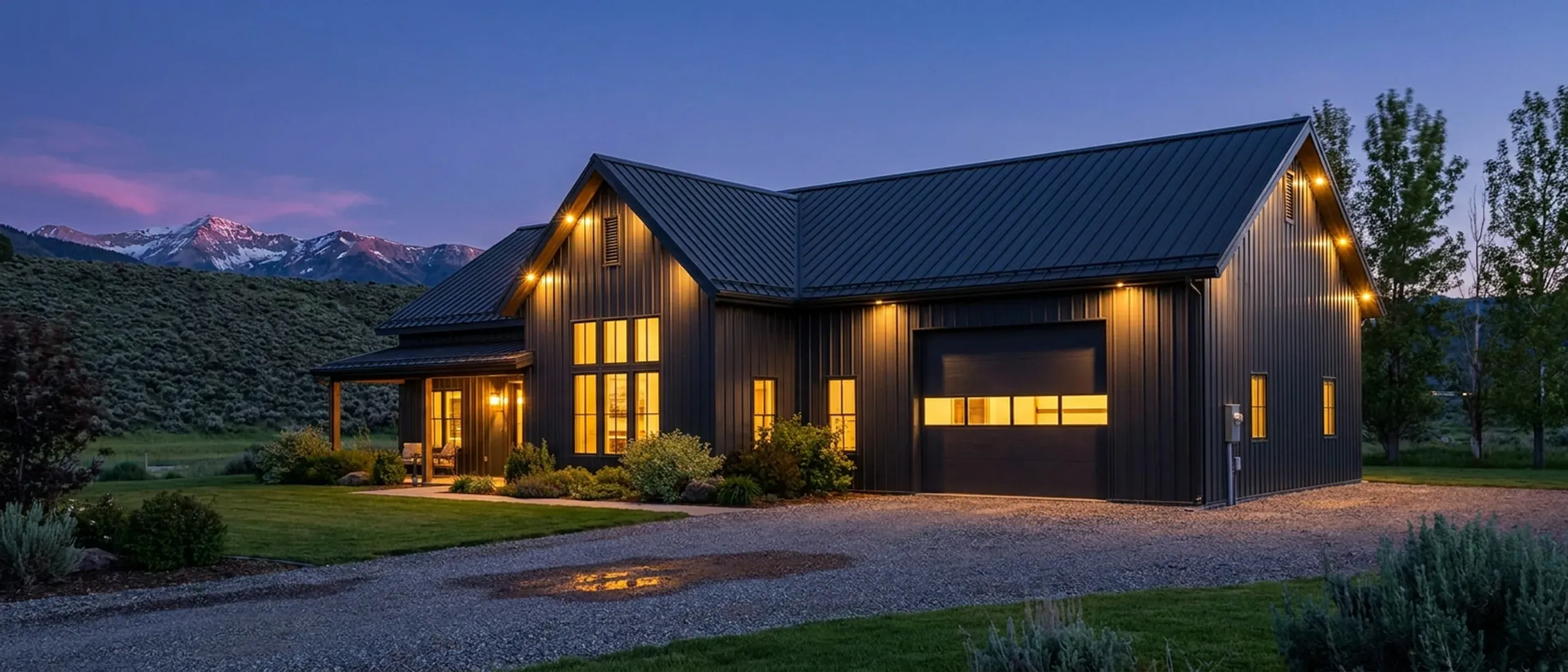
Barndominium Builders in Idaho
We are Idaho barndominium builders for barndominium kits, custom floor plans and turnkey builds on private land across Idaho, from the Treasure Valley to Idaho Falls and the Panhandle, with the shop and the house under one roof. Buy the kit, buy the shell, or hand us the whole project from bare land to keys, with one point of contact from the first drawing to the final walkthrough.
Barndominium kits, pole barn homes and turnkey builds in Idaho
Nine ways to get a barndominium out of your head and onto your land in Idaho, from a barndominium kit you put up yourself to a finished steel-frame or pole barn home we hand you the keys to.
Barndominium Kits
Barndominium kits for sale in Idaho: steel and pole barn shell kits sized to the snow load your building department sets, with honest help on kit prices.
Custom Plans
Custom barndominium plans for Idaho land, drawn around your site, snow load and zoning, and the Idaho residential code your building department enforces.
Pole Barn Homes
Pole barn homes and pole barn home kits in Idaho, built as real dwellings under the Idaho residential code and sized to your site's snow load.
Shouses
Shop houses in Idaho: a heated working shop and a home under one roof, planned around your zoning, snow load and the residential code.
Metal Homes
Metal building homes in Idaho, finished as real houses: insulated for long winters, detailed against condensation, and clad for wildfire country.
Steel Construction
Steel and metal building construction in Idaho: red-iron frames and steel building kits for barndominiums, sized to your site's snow load.
Turnkey Builds
Turnkey barndominiums in Idaho, from raw land to move-in: zoning, septic, well, snow load and permits handled in the order each has to come.
Site Preparation
Barndominium site preparation in Idaho: ditches, septic evaluation and well location first, then clearing, drive, pad and drainage for a sound foundation.
Permitting & Approvals
Barndominium permits in Idaho, in order: zoning with the county or city, septic with the health district, then the building permit where one is issued.
Barndominium kits in Idaho: kit, shell or turnkey
Most people who look for a barndominium in Idaho start with a kit. A barndominium kit is the structural package: an engineered steel or pole barn (post-frame) frame, the roof and wall panels, trim, fasteners and the doors the package names. It is delivered to your land and put up on a slab or foundation there. You can buy the kit and build it yourself, have us put it up to a dried-in shell, or have us build the whole home.
Prefab, modular and manufactured are words people use for the same idea, but they are not the same thing. A kit is prefabricated in the sense that its parts are cut and made in a factory, but the house is assembled and finished on your land. A modular home arrives as finished boxes built in a factory, and a manufactured home is built whole in a factory to the federal HUD code and set on site. What we sell and build are kits and site-built barndominiums; the barndominium kits page sets out what each option includes and what it leaves out.
Kit package
The engineered frame, roof and wall panels, trim, fasteners and the doors the package names, delivered to your land for you or your own crew to put up.
Dried-in shell
We pour the slab and put the kit up to a weather-tight shell, and you finish the inside yourself or with your own trades.
Turnkey build
The whole project from bare land to keys: site work, slab, shell and finished interior, with one point of contact throughout.
Pole barn homes and kits
A pole barn home is a house built on a pole barn frame: large posts set wide apart carry the roof, so the inside is open to lay out however you like, with room for a shop bay or equipment under the same roof. Pole building, pole barn and post-frame all describe the same way of framing. We supply pole barn home kits and build pole barn homes to the shell or to the keys, with the frame sized to the snow load set for your site by the local building official or the engineer on the project.
Barndominium floor plans
Start from one of our barndominium floor plans and change it, or have a plan drawn from scratch around your land, your shop and the way you live. Either way the plan is fitted to the parcel: where the septic system and well can go, which way the lot drains, and what the county setbacks allow.
Thinking small? A small barndominium is often the fastest route onto your land, and the size-for-budget guide walks through how the footprint and the budget trade against each other.
How much does it cost to build a barndominium in Idaho?
We do not publish a price list, because on an Idaho barndominium the land moves the number more than the floor plan does: the driveway, the pad, how far power has to run, a well and a septic system, the snow load the frame is sized for, and what the planning and building offices ask for. The cost guide sets out published third-party cost data, every figure with its source, with a calculator built on those same cited ranges, and walks through what pushes a build to the top or bottom of the range.
Know which of these you want? A plan drawn for your land is where it starts.
Land to keys, in four stages
In Idaho, barndominium projects go wrong early, at zoning, septic, water and site checks, long before anyone pours concrete. Here is the order we work in and why.
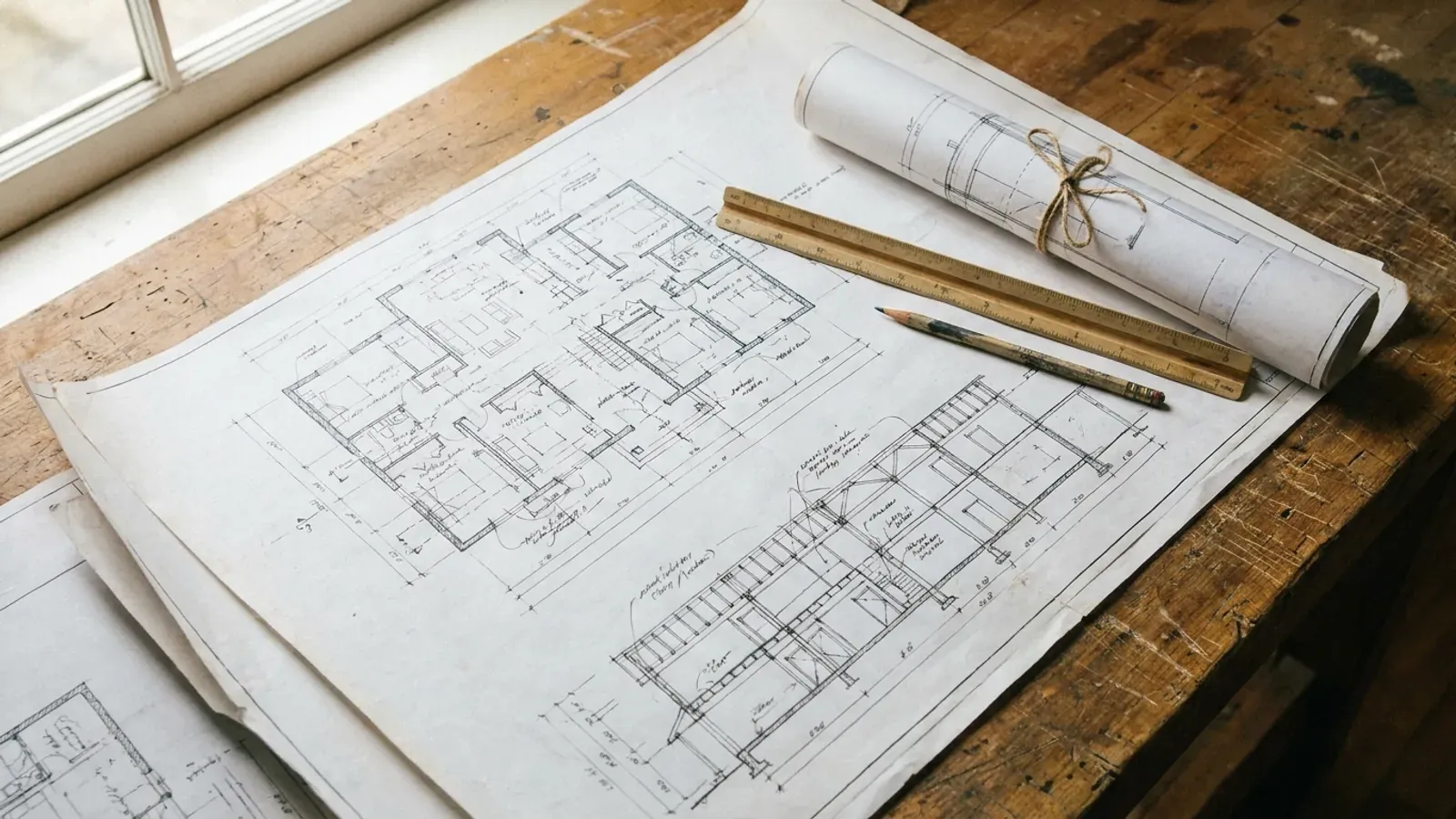
Start your plans
Start the survey. We take your program, the rooms, the shop bay, how you actually want to live in it, and start a floor plan drawn for your land rather than pulled off a shelf, whether you bring a sketch, a saved layout or a blank sheet. This is where most of the useful decisions get made.
That is how a build runs. Step one is a plan drawn for your land, and that starts with the survey.
Building a barndominium in Idaho
Four things shape an Idaho build before anyone pours concrete, and the first of them is which office, if any, reviews and inspects the house where your land is.
Who issues the permit
Idaho homes are built to the Idaho Residential Code, but Idaho leaves enforcement to cities and counties: one that issues building permits must use the state-adopted codes, and some rural counties do not run a residential building-permit program at all. Where there is none, there is no local building permit or inspection, but electrical, plumbing and HVAC work still needs permits and inspections, and zoning, septic and well rules still apply. We confirm which case your parcel is in first.
How we handle permittingSnow load is set for your site
Idaho snow loads vary sharply with elevation. The University of Idaho's Ground Snow Loads for Idaho study is the common reference, but the design snow load for your lot is set by the local building official or the engineer on the project, and frost depth is set locally too. The frame is sized to the figures for your site, which is why a kit is quoted for the address it is going to.
Pole barn homesSeptic and well on rural land
Off city sewer and water, the parcel needs a septic system and usually a well. Every septic system in Idaho needs an installation permit, and site evaluations, permits and inspections are handled by the public health district for your county. A single-home well does not need a water-right permit in most of Idaho, but it does need a drilling permit from the Department of Water Resources and a licensed well driller. We check both early, because the septic site can decide where the house goes.
Site preparationZoning, water and the land
Every Idaho county zones its unincorporated land, even where it does not issue building permits, so zoning decides whether a home is allowed on the parcel. In irrigated country, ditches and canals carry a legal right-of-way: you cannot build, fence or landscape in it without the ditch owner's written permission. We check both before the house is sited.
Are barndominiums legal in Idaho?Barndominium builders across Idaho
Looking for barndominium builders near you? We build in seven regions of Idaho, from Boise and the Treasure Valley to the Magic Valley, Pocatello, Idaho Falls and the Panhandle. Inside Boise, Meridian, Nampa and the other larger cities most land is already subdivided, so most of our work is on rural and edge-of-town parcels in the counties around them. Zoning, building permits and septic approvals sit with different offices from one county to the next, so every project starts with the parcel.
- Boise
- Meridian
- Nampa
- Caldwell
- Eagle
- Kuna
- Star
- Middleton
- Emmett
- Ada County
- Canyon County
- Gem County
- Payette County
- Mountain Home
- McCall
- Elmore County
- Owyhee County
- Valley County
- Boise County
Building in Idaho: common questions
18 questions we get asked most often about building in Idaho. If yours is not on the list, ask it directly.
Do you build barndominiums across Idaho?
Do you build on land I already own?
Do you sell barndominium kits in Idaho, or only full builds?
Are barndominium kits the same as modular, prefab or manufactured homes?
What is the difference between a barndominium, a pole barn home and a metal building home?
How much does it cost to build a barndominium in Idaho?
Is a barndominium cheaper to build than a traditional house?
Do I need a building permit for a barndominium in Idaho?
Can a barndominium be built as an agricultural building to avoid the code?
Who approves the septic system and the well?
How much snow does a barndominium roof have to carry in Idaho?
What should I check on rural land before I buy it?
How do I check a barndominium builder in Idaho?
Can I build a small barndominium?
Can you build a shop house, with living space and a shop under one roof?
Can I finance a barndominium like a normal house?
Who handles plumbing, electrical and HVAC?
How do I get started?
Got land in Idaho? Tell us about it.
Start the survey with your parcel and we will come back with what the zoning allows on it, who has to approve the build, and what drives the cost, then a written quote before anything is ordered. No charge for that conversation.