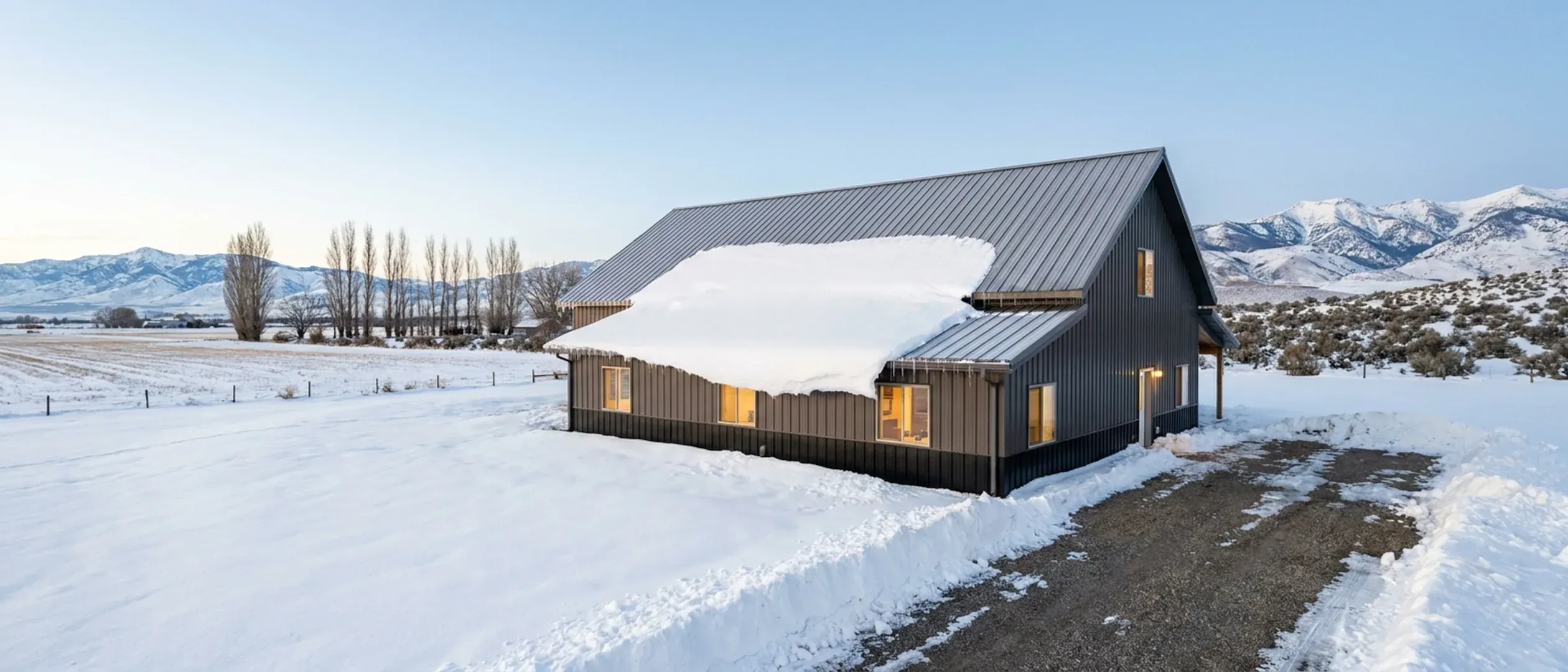
How Long Does It Take to Build a Barndominium in Idaho? The Stages and What Each Waits On
How long a barndominium takes in Idaho depends less on the building than on the land and the season. Before anything goes up, the county has to allow a house on the parcel, the public health district has to approve a septic system, the Idaho Department of Water Resources has to issue a drilling permit for the well, and, where the city or county runs a building program, the plans have to be approved. Some rural counties issue no residential building permit at all, which removes one step but not the others. Once those are done, a kit shell goes up quickly and the rest is the same trade sequence as any house. The weather sets the rest of the calendar. In the Treasure Valley average overnight lows are below freezing from November through February; on the upper Snake River Plain around Idaho Falls they are below freezing from October through April; and in the mountains around McCall snow lies on the ground for months. This page sets out the stages in order, what each one waits on, and the Idaho pieces behind them. For a benchmark, the Census Bureau reports that single-family houses in its West region started in 2025 took an average of 14.0 months from start to completion when built by a contractor on the owner's land, and 15.6 months when the owner acted as builder. Those are conventional houses, and the months before the start are extra.
Figures on this page are cited third-party or government data, not a quote from Idaho Barndominium Builders.
Bottom Line Up Front
- In Idaho most of the early calendar goes to the land: the county zoning answer, the septic site evaluation and permit from the public health district, the well drilling permit and, where the city or county runs a building program, plan review. Starting those early is the biggest single saving.
- As a benchmark, the Census Bureau reports 14.0 months from start to completion for contractor-built single-family houses started in its West region in 2025, and 15.6 months for owner-built ones.
- Plan concrete and erection around frozen ground and snow: average overnight lows are below freezing from November to February in Boise and from October to April in Idaho Falls, and McCall averages more than 130 inches of snow a year.
The stages, and what each one waits on
Some of these overlap, and the order of the first few can change. In Idaho the first four decide whether the rest can happen at all.
1. Land due diligence and zoning
Before buying or committing to a site: the zone, whether a house is allowed, the minimum lot size and setbacks, road access, flood risk, and whether an irrigation ditch or canal crosses the land. Idaho Code §42-1102 and §42-1209 bar structures, fences and landscaping in a ditch right-of-way without the ditch owner's written permission, so ditches shape where the house and driveway can go.
2. Find out who issues the building permit
Ask the county planning and zoning office, or the city inside city limits, whether it issues residential building permits. The answer decides whether plan review is on the schedule and who gives you the site's design snow load and frost depth.
3. Septic site evaluation and permit
The public health district for the county evaluates the soil and issues the installation permit. A site that needs a complex system, such as a sand mound or pressure distribution, needs a complex-system installer and more design time.
4. Well drilling permit and water
The driller or owner obtains a drilling permit from the Idaho Department of Water Resources before construction begins. Drilling is its own project with its own scheduling, and it can run alongside the design.
5. Survey, soil and design
A boundary survey fixes where the building can go, and a soil test tells the foundation designer what the ground will do. The floor plan, the kit or frame and the manufacturer's engineering follow. Idaho sets no statewide snow load; the University of Idaho's Ground Snow Loads for Idaho study is the common reference, and the building official or your engineer sets the figure for your lot, so find it out before ordering.
6. Building permit review, where there is one
Plans go to the city or county building department. Idaho Code §54-5209 has the permit record the contractor's registration number, or "no contractor registration provided" when the applicant claims an exemption from registration. Where the county has no building program, this step drops out, but the frame and foundation still need engineering for the site.
7. Dig notice, then site work
Idaho Code §55-2205 requires notice through the one-number notification service at least two and no more than ten business days before digging, and a new notice if work has not begun within three weeks. Then come clearing, grading, the driveway and the building pad. On wooded land, burning slash between May 10 and October 20 needs a permit from the fire warden in a forest protective district under Idaho Code §38-115.
8. Foundation
Piers or posts for a pole barn frame, or a slab or stem wall for a steel frame, set below the frost depth for the site. Cold weather is the main risk to this stage: plan pours before freezing nights set in, or plan to protect the concrete while it cures.
9. Frame and shell
Erecting the frame, then the roof and wall panels. With the materials on site this is often the quickest visible stage, but snow on an open frame slows it, so aim to dry the building in before winter.
10. Rough-ins and trade permits
Electrical, plumbing and HVAC need permits and inspections whether or not the county issues building permits, from DOPL or from the local program where one handles them. Licensed trade contractors do this work.
11. Insulation, drywall and finishes
Insulation follows the Idaho energy code for your climate zone. The EPA's moisture-control guidance says drywall, finished woodwork, cabinets and mechanical equipment should be kept in weather-protected storage or installed in their final protected locations on delivery, and that concrete must be thoroughly dry before it is covered with flooring or paint.
12. Finals and moving in
Final trade inspections, the building final where there is a building department, and the health district's septic inspection. Once the home is your primary residence, you can apply to the county assessor for Idaho's homeowner's exemption.
What usually adds time
These are the delays most often found on rural Idaho parcels.
A septic site that needs a complex system
Shallow soil, high groundwater or slope can push a site from a standard system to a complex one, with more design and a different installer.
A ditch, canal or irrigation easement in the wrong place
Written permission from the ditch owner, or a different house site, takes time to arrange, and building in the right-of-way without it risks removal at your cost.
Starting the foundation too late in the year
In eastern Idaho and the mountains, a foundation started in autumn can end up waiting until spring.
Changing the design after ordering
A kit is engineered for a set design and snow load. Changing spans, openings or the roof after ordering means new engineering.
Lead times on the kit and the trades
Frame packages, windows and trade contractors all book ahead in the building season. Ask for lead times before choosing a start date.
How to shorten the schedule
The time saved is almost all at the start.
Get the zoning and permit answer before buying
Ask the county whether a house is allowed and whether it issues building permits, in writing if you can.
Order the septic site evaluation early
DEQ advises doing it before buying the property. Its result shapes the house site and the budget.
Settle the snow load before ordering the kit
Ask the building official or your engineer for the design snow load for the lot, and give it to the kit manufacturer.
Time the foundation for the season
Aim to pour in dry, frost-free weather and to have the shell closed in before the first hard freeze, earlier in eastern Idaho and the mountains than in the Treasure Valley.
Reading this because you are weighing a build? The next step is a plan drawn for your program.
What's different about Idaho
A national survey gives the benchmark
The Census Bureau's Survey of Construction reports that single-family houses started in its West region in 2025 averaged 14.0 months from start to completion when contractor-built on the owner's land, 15.6 months when owner-built, and 6.4 months when built for sale by a developer. The time from permit authorization to start averaged 1.5 months for contractor-built houses and 2.1 months for owner-built ones. The survey measures conventional houses, not barndominiums, and a kit shell can shorten the framing stage. It is still a fair guide to how long the trades and finishes take, and it says nothing about the zoning, septic and well steps that come before a start.
The county decides the first steps
Idaho's Local Land Use Planning Act requires each city and county to adopt zoning, so the first question is whether the zone allows a house on the parcel and on what lot size and setbacks. The second is whether the county, or the city inside city limits, runs a building program. Idaho Code §39-4116 lets local governments choose whether to enforce building codes, so some rural counties issue residential building permits and some do not. Where they do, plan review is a step of its own. Where they do not, electrical, plumbing and HVAC permits still apply. The legal guide explains both cases.
Septic and the well run in parallel
Every septic system needs an installation permit under IDAPA 58.01.03, and the public health district for the county does the site evaluation, issues the permit and inspects the installation. The Department of Environmental Quality advises having the site evaluation done before buying the property, and the application includes a statement from the local zoning or building authority, so the zoning answer comes first here too. A household well needs no water right in most cases, but Idaho Code §42-235 requires a drilling permit from the Department of Water Resources before construction, and the driller must be licensed. Both can run while the design is drawn.
Treasure Valley and Magic Valley winters
The Western Regional Climate Center's long-term record for Boise Air Terminal shows average overnight lows below freezing from November through February, a January average low of 22.6 degrees, about 19.6 inches of snow a year and a very dry summer, with 0.25 inches of precipitation in an average July. Twin Falls is similar, with average lows below freezing from November through March. That gives the lower valleys a long building season, but concrete placed in a cold snap still needs protecting while it cures, and the dry summer is the easiest time to pour, erect and close in.
Eastern Idaho and the mountains
Higher up, the season is shorter. The Western Regional Climate Center's narrative says monthly mean temperatures stay at or below freezing from December through February in the Snake River basin between Twin Falls and Idaho Falls, and from November through March at stations above 5,000 feet. Its record for Idaho Falls Fanning Field shows average overnight lows below freezing from October through April, a January average low of 10.2 degrees, about 35 inches of snow a year and snow on the ground through winter. McCall averages 134.2 inches of snow a year and 26 to 32 inches on the ground from January through March. Pocatello averages about 40 inches. In these places a schedule that has the foundation in and the shell closed before winter avoids most of the delay.
North Idaho is wetter
The Western Regional Climate Center's record for Coeur d'Alene shows about 25 inches of precipitation a year, with more than three inches in an average December and January, and about 46 inches of snow a year. The narrative describes a winter-maximum, dry-summer pattern across the north and west of the state, and spring snowmelt floods most often in April and May. Keeping materials dry during construction matters most here.
Pros and cons, honestly
Pros
- A kit shell goes up quickly once the foundation is in.
- Where the county has no building program, there is no plan-review wait, although trade permits remain.
- Septic, well and design work can run in parallel.
- The Treasure Valley's dry summers give a long, predictable building season.
Cons
- Septic approval and the zoning answer can take longer than the build itself.
- Frozen ground and snow shorten the season in eastern Idaho and the mountains.
- Irrigation ditches and easements can force a different house site.
- Trade contractors and kit suppliers book ahead in the building season.
- A late design change means re-engineering the frame.
How long does it take to build a barndominium in Idaho?
What should I do first?
Can I build a barndominium in an Idaho winter?
Does a county with no building permit make the build faster?
When should I call before digging?
How long does a septic permit take?
Do I need a permit to clear and burn brush on my land?
Questions answered? Tell us what you want to build and we will put real numbers against it.
Sources
- U.S. Census Bureau — Survey of Construction, average months from start to completion (West region)
- U.S. Census Bureau — Survey of Construction, average months from authorization to start (West region)
- Western Regional Climate Center — Climate of Idaho
- Western Regional Climate Center — Boise Air Terminal monthly climate summary
- Western Regional Climate Center — Idaho Falls Fanning Field monthly climate summary
- Western Regional Climate Center — McCall monthly climate summary
- Western Regional Climate Center — Coeur d'Alene monthly climate summary
- Western Regional Climate Center — Twin Falls monthly climate summary
- Western Regional Climate Center — Pocatello Regional Airport monthly climate summary
- Idaho Code §39-4116 — Local government adoption and enforcement of building codes
- IDAPA 58.01.03 — Individual/Subsurface Sewage Disposal Rules
- Idaho Department of Environmental Quality — Septic and Septage
- Idaho Code §42-235 — Drilling permits
- Idaho Code §42-1102 — Right-of-way for ditches and canals
- Idaho Code §42-1209 — Encroachments on irrigation easements and rights-of-way
- Idaho Code §54-5209 — Building permits and contractor registration number
- Idaho Code §55-2205 — Notice of excavation
- Idaho Code §38-115 — Closed season for fires
- University of Idaho — Ground and Roof Snow Loads for Idaho
- Division of Occupational and Professional Licenses — HVAC FAQ (permits where there is a local building permit)
- U.S. EPA — Moisture Control Guidance for Building Design, Construction and Maintenance
- Idaho Code §63-602G — Homeowner's exemption
Keep reading
The pages that answer the next question this one raises.
Are barndominiums legal in Idaho?
The code, who enforces it, zoning, septic, wells and ditches.
Read itBarndominium pros and cons in Idaho
Snow, cold, wildfire, insurance and appraisal.
Read itBarndominium cost
What drives the budget, with sourced figures.
Read itSite preparation
Clearing, grading, pads and driveways.
Read itPermits for a barndominium
How the permit process works.
Read itStart the survey
Tell us about your land and your timing.
Read itWant a real number instead of a range?
Start the survey and tell us about your land and what you want to build. Include the county and parcel number if you have them, because in Idaho the zoning, the septic permit, the well and the power line to the site change the budget more than the building does. The survey costs nothing.