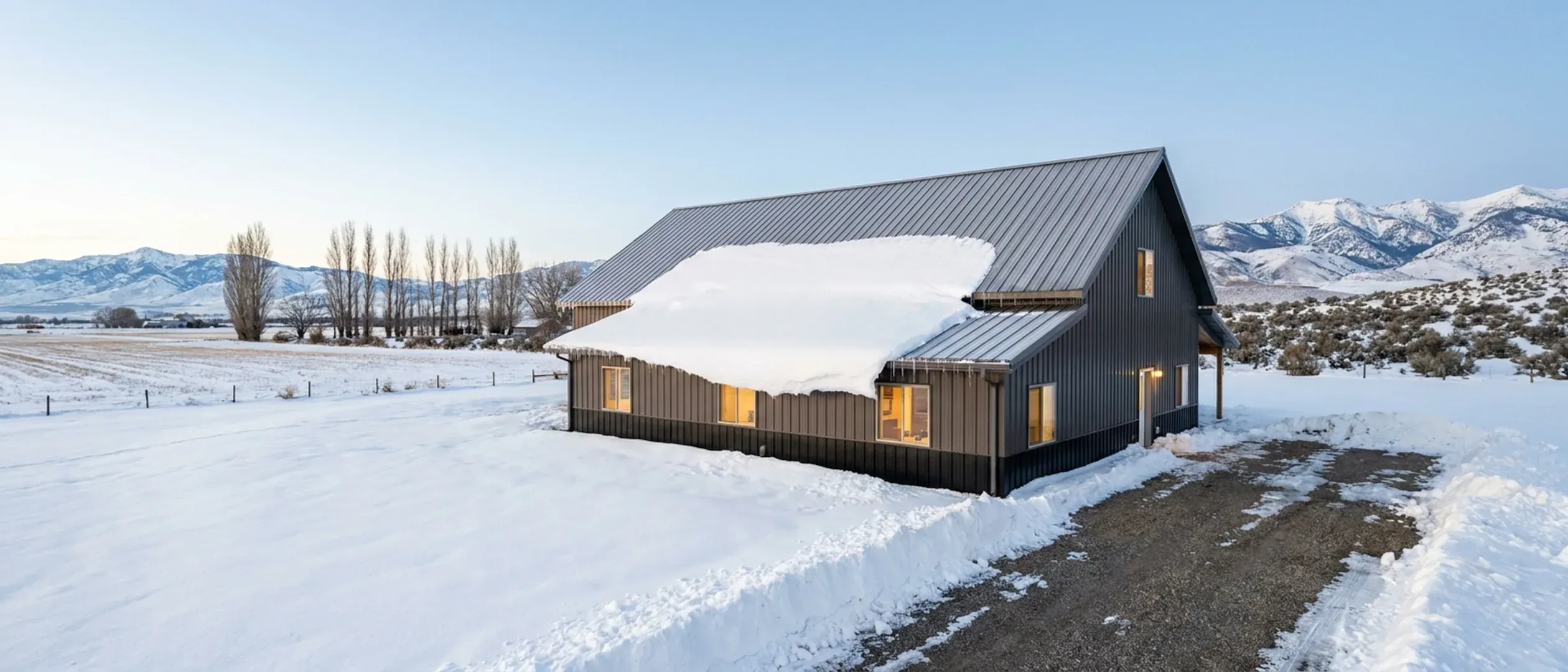
Are Barndominiums Legal in Idaho? Building Code, Zoning, Septic, Wells and Snow Loads
Yes, barndominiums are legal in Idaho. No state law singles them out. A barndominium with living space is a dwelling, and Idaho's residential code for dwellings is the Idaho Residential Code, which is the 2018 International Residential Code as adopted and amended by the Idaho Building Code Board. The unusual part is enforcement. Idaho leaves building-code enforcement to cities and counties, and a local government may choose whether to run a building program at all. Where one does, you get a building permit and inspections. Where one does not, there is no local building permit or building inspection, but electrical, plumbing and HVAC work still needs permits and inspections, and the county's zoning, the public health district's septic rules and the state's well rules still apply. This page takes each layer in turn: the code, who enforces it, the agricultural-building exemption, zoning, septic, wells, irrigation ditches, snow loads and the rules on contractors. It cites the statute or agency behind every rule and ends with the questions to ask before you buy land. It is general information, not legal advice for a particular parcel.
Figures on this page are cited third-party or government data, not a quote from Idaho Barndominium Builders.
Bottom Line Up Front
- A barndominium is legal in Idaho as a house. The residential code is the Idaho Residential Code, based on the 2018 International Residential Code, and the agricultural-building exemption expressly excludes any space used for living, sleeping or cooking.
- Enforcement is local and optional. A city or county that issues building permits must use the state-adopted codes; some rural counties do not run a residential building program at all. Electrical, plumbing and HVAC permits, zoning, septic and well rules apply either way.
- On rural land the deciding approvals are the county zoning, a septic permit from the public health district for the county, an Idaho Department of Water Resources drilling permit for the well, and written permission before building in any irrigation ditch right-of-way.
Septic, wells and irrigation ditches
Most Idaho barndominiums are built beyond sewer and water mains, and on irrigated land a ditch often crosses the parcel. These approvals sit alongside, or in place of, the building permit.
Every septic system needs an installation permit
Under Idaho's Individual/Subsurface Sewage Disposal Rules, IDAPA 58.01.03, no one may install, modify, repair or expand a septic system without a valid installation permit. The application includes a site evaluation with a soil description and groundwater data, and a statement from the local zoning or building authority that the system would not be contrary to local ordinances.
The public health district for the county handles it
The Department of Environmental Quality writes the septic rules, but it says to contact the public health district for the county where the property is located, which handles site evaluations, permits and inspections. Idaho Code §39-408 establishes seven districts, each covering a fixed list of counties: Panhandle Health District, Public Health-Idaho North Central Health District, Southwest District Health, Central District Health, South Central Public Health District, Southeastern Idaho Public Health and Eastern Idaho Public Health. DEQ advises having the site evaluation done before you buy the property.
Who may install a septic system
IDAPA 58.01.03 requires every installer to hold a registration permit, basic or complex. DEQ's guidance says all septic systems must be installed by a licensed basic or complex installer, unless a homeowner installs a standard or basic system on their own property with no hired help. Complex systems, such as sand mounds and pressure distribution systems, need a complex installer.
A household well needs no water-right permit, but it needs a drilling permit
Idaho Code §42-227 exempts wells for domestic purposes from the water-right permit process, and §42-111 defines domestic purposes to include a home and irrigation of up to half an acre, if total use does not exceed 13,000 gallons a day. Under §42-235 the driller or well owner must still obtain a drilling permit from the Idaho Department of Water Resources before construction, and §42-227 requires well drillers to be licensed. For new subdivisions of five or more lots applied for from July 1, 2025 in a moratorium, critical ground water or ground water management area, §42-227(4) requires a water-right permit for domestic uses other than in-home use and livestock.
Ditch and canal rights-of-way
Idaho Code §42-1102 gives the owner of an irrigation ditch, canal or drain a right-of-way across other people's land, including the right to enter it for maintenance without notice, and bars roads, utilities, fences, structures, landscaping and trees in the right-of-way without the ditch owner's written permission. Section 42-1209 applies the same rule to the easements of irrigation districts, canal companies, lateral ditch associations and drainage districts, and makes whoever caused an encroachment pay to remove it if it interferes. On irrigated land, find every ditch before siting the house.
The dig notice
Idaho Code §55-2205 requires anyone excavating to notify underground facility owners through the one-number notification service at least two and no more than ten business days before digging starts, and to give notice again if excavation has not begun within three weeks. That covers the foundation, the septic lines, the well trench and the driveway.
Code details that affect a barndominium
The code is statewide, but several figures that matter most to a large metal-clad building are set for each site.
Snow load is set locally, not statewide
Idaho Code §39-4116(4) lets a local jurisdiction amend Section R301, the design-criteria section of the residential code, to reflect local concerns, and the state rule publishes no statewide snow load. The common reference is Ground Snow Loads for Idaho, 2015 Edition, from the University of Idaho's Department of Civil Engineering. The report says it is not legally binding, urges users to verify ground snow load values with the local authority having jurisdiction, and says design snow loads are the responsibility of the person in charge of the project. A kit frame has to be engineered for the load at your site, which your building official or engineer sets.
Frost depth is set for your site
There is no statewide frost-depth figure in the Idaho Building Code Act or the state rule. It is part of the local design criteria, so the building department, or your engineer where there is none, gives you the figure for your site.
Energy requirements
Idaho Code §39-4116 requires jurisdictions that enforce codes to adopt the 2018 Idaho Energy Conservation Code, and IDAPA 24.39.30 adopts the residential provisions of the 2018 International Energy Conservation Code with Idaho amendments. Insulation and window requirements follow that code for your climate zone, like any other house.
No statewide wildfire building code
DOPL's list of codes adopted in Idaho includes building, energy, electrical, plumbing, mechanical and fire codes, but no wildland-urban interface code. Some cities and counties adopt wildfire construction rules locally, so ask the building department on a wooded or range-land parcel.
Plans for a house
Idaho Code §54-306 exempts architectural services for a single-family residence, or a multifamily residence of up to three units or three stories, and for farm buildings and their outbuildings, from the architect licensing chapter. Engineering is different: under Idaho Code §54-1202, anyone who represents himself to be a professional engineer is practising engineering, so ask for the registration of whoever engineers the frame or foundation.
Contractors and your contract
Idaho registers construction contractors rather than licensing them. Three provisions protect a buyer directly.
Contractors must register
Idaho Code §54-5204 makes it unlawful to engage in the business of, or hold oneself out as, a contractor in Idaho without registering with the Idaho Contractors Board, which DOPL administers. DOPL's contractor FAQ says the Act requires registration, not licensure. You can check a builder's registration on DOPL's license search before you sign. Under §54-5214 a registered contractor must display the registration number on advertising, contracts and permits, and under §54-5209 a building permit records the number, or the phrase "no contractor registration provided" when the applicant claims an exemption.
The disclosure before a residential contract
Idaho Code §45-525 requires a general contractor, before entering into a contract over $2,000 with a homeowner to build or improve residential property, to give the homeowner a written disclosure. It must tell you that you may require lien waivers from subcontractors, receive proof of the contractor's general liability and workers' compensation insurance, buy an extended title insurance policy covering certain unrecorded liens, and require a surety bond at your own expense.
Building on your own property
Idaho Code §54-5205 exempts an owner performing construction on the owner's own residential property from contractor registration, unless the owner is building to sell promptly. The exemption does not remove the need for permits: a permit issued to an exempt owner is marked "no contractor registration provided", and the trade permits, septic permit and well permit still apply.
What to ask before you buy or apply
Each of these can be answered before money goes into land, a kit or a design.
Does the county, or the city, issue residential building permits here?
Ask the planning and zoning office. If it does, the building department will tell you the design snow load, frost depth and other criteria for the site. If it does not, ask who handles electrical, plumbing and HVAC permits, and plan on having the frame and foundation engineered for the site.
What is the zone, and does it allow a house?
Ask for the zone, the minimum lot size, the setbacks and any limits on accessory buildings or a shop, in writing if you can.
Will the soil take a septic system?
A site evaluation by the public health district for the county answers it, and DEQ recommends doing that before you buy.
Where will the water come from?
Check nearby well records with the Department of Water Resources, and whether the parcel sits in a moratorium, critical ground water or ground water management area.
Is there a ditch, canal or irrigation easement on the land?
Walk the parcel, read the title report and ask the irrigation district or ditch owner. Nothing can be built in the right-of-way without written permission.
Is there a farm next door?
Idaho Code §22-4503 says an agricultural operation that has been running for more than a year and was not a nuisance when it began does not become one because of changed surrounding conditions. Dust, noise and smell from an established farm come with the land.
Reading this because you are weighing a build? The next step is a plan drawn for your program.
What's different about Idaho
One residential code, adopted by the state
The Idaho Building Code Act, Idaho Code Title 39, chapter 41, gives the Idaho Building Code Board, within the Division of Occupational and Professional Licenses (DOPL), the job of adopting codes by rule. Under Idaho Code §39-4109, the International Residential Code as adopted and amended by the board is named the Idaho Residential Code. The board's rule, IDAPA 24.39.30, adopts Parts I, II, III and IX of the 2018 edition for one- and two-family dwellings, with Idaho amendments. DOPL's list of adopted codes calls it the 2020 Edition of the Idaho Residential Code, and explains that the 2020 label refers to the legislative session in which the amendments were adopted, not to a newer code. A new edition takes effect on January 1 of the year after the board adopts it.
Local governments choose whether to enforce it
Idaho Code §39-4116 says local governments that had no code enforcement program when the Act took effect may elect to implement one by passing an ordinance. A city or county that issues building permits must adopt the state-adopted codes, including the Idaho Residential Code and the Idaho energy code, and may not adopt residential provisions the board has not adopted. Idaho Code §39-4111 makes it unlawful to build without a permit in a jurisdiction that enforces building codes. The result is that some rural counties issue residential building permits and some do not, and inside city limits the city usually does. The county or city planning and zoning office can tell you which applies to a parcel.
Where no local program exists
Where a county has no building program, there is no local building permit or building inspection. That does not mean no code applies, and it does not make the state the building department: DOPL's building jurisdiction covers state-owned buildings, modular buildings in the factory and manufactured-home installation, not private houses. What still applies is everything else. DOPL's FAQ says that even with a local building permit, it may still be necessary to obtain permits from DOPL for electrical, plumbing or HVAC work, and that homeowners may buy those permits for work on their own primary and secondary residence and related outbuildings. Zoning, septic and well rules apply regardless.
A dwelling is never an agricultural building
Idaho Code §39-4116(5) requires local governments to exempt agricultural buildings, including barns, from the codes, and bars counties from narrowing that exemption. The same subsection says an agricultural building does not include a place of human habitation, which it defines as a space in a building for living, sleeping or cooking. A barndominium with living space is therefore a house, permitted and built as one. A shop or barn with no living space can fall under the exemption, although a county may still issue a permit for it to check road setbacks and utility easements.
Every county zones its land
Idaho's Local Land Use Planning Act, Idaho Code Title 67, chapter 65, applies to every city and county. Idaho Code §67-6503 says every city and county shall exercise the powers the Act confers, and §67-6511 requires each governing board to establish zoning districts in accordance with its comprehensive plan, with standards for the size, height and use of buildings and the density of population. So a county that issues no building permits still has a zoning ordinance, and the zone decides whether a house is allowed on a parcel, the minimum lot size and the setbacks.
No fire-sprinkler mandate for a house
Idaho Code §39-4116(3) exempts single-family homes and dwellings of up to two units from any code provision that would require an automatic fire sprinkler system. An owner may still install one voluntarily.
Pros and cons, honestly
Pros
- No state law singles out barndominiums; they are permitted as houses.
- One residential code statewide, so the rules do not change from county to county where they are enforced.
- A household well needs no water-right permit in most cases.
- No fire-sprinkler requirement can be imposed on a single-family house.
- Under Idaho Code §54-306, architectural services for a single-family house are exempt from the architect licensing chapter.
Cons
- Enforcement varies: some counties issue building permits and some do not, so the process depends on the parcel.
- A barn or shop cannot be lived in under the agricultural exemption; living space makes it a house.
- The septic site evaluation, not the building, decides whether many rural parcels work.
- Irrigation ditch rights-of-way restrict where the house, fences and driveway can go.
- Snow load and frost depth are site figures, so a kit frame must be engineered for your lot.
Are barndominiums legal in Idaho?
Do I need a building permit for a barndominium in Idaho?
Does the state inspect my house if the county has no building department?
Is a barndominium exempt as an agricultural building?
What building code applies to a barndominium in Idaho?
Who issues septic permits in Idaho?
Do I need a permit to drill a well for my house?
What snow load does a barndominium need in Idaho?
Can I build my own barndominium in Idaho?
Questions answered? Tell us what you want to build and we will put real numbers against it.
Sources
- Idaho Code §39-4116 — Local government adoption and enforcement of building codes
- Idaho Code §39-4109 — Application of codes
- Idaho Building Code Act, Idaho Code Title 39, chapter 41 (whole chapter, including §39-4111)
- IDAPA 24.39.30 — Rules of Building Safety (Building Code Rules)
- Division of Occupational and Professional Licenses — Idaho Adopted Codes
- Division of Occupational and Professional Licenses — Building program FAQ
- Division of Occupational and Professional Licenses — HVAC FAQ (permits where there is a local building permit)
- University of Idaho — Ground and Roof Snow Loads for Idaho (2015 Edition report and map)
- IDAPA 58.01.03 — Individual/Subsurface Sewage Disposal Rules
- Idaho Department of Environmental Quality — Septic and Septage
- Idaho Code §39-408 — Public health districts
- Idaho Department of Health and Welfare — Public Health Districts
- Idaho Code §42-111 — Domestic purposes defined
- Idaho Code §42-227 — Wells for domestic purposes
- Idaho Code §42-235 — Drilling permits
- Idaho Code §42-1102 — Right-of-way for ditches and canals
- Idaho Code §42-1209 — Encroachments on irrigation easements and rights-of-way
- Idaho Code §55-2205 — Notice of excavation
- Idaho Code §67-6503 — Participation of local governments (Local Land Use Planning Act)
- Idaho Code §67-6511 — Zoning ordinance
- Idaho Code §22-4503 — Agricultural operations not a nuisance
- Idaho Code §54-306 — Architects: exemptions
- Idaho Code §54-1202 — Engineers and surveyors: definitions
- Idaho Contractor Registration Act, Idaho Code Title 54, chapter 52 (§54-5204, 54-5205, 54-5209, 54-5214)
- Division of Occupational and Professional Licenses — Contractors FAQ
- Idaho Code §45-525 — General contractors, residential property disclosures
Keep reading
The pages that answer the next question this one raises.
Barndominium build timeline
Where zoning, septic, the well and permits fall in the schedule.
Read itBarndominium pros and cons in Idaho
Snow, cold, wildfire, insurance and appraisal.
Read itAre barndominiums worth it in Idaho?
When the land and the building add up.
Read itPermits for a barndominium
How the permit process works, and what gets reviewed.
Read itSite preparation
Grading, driveways, pads and the dig notice.
Read itService areas
Local notes on who issues permits and which health district handles septic.
Read itStart the survey
Tell us about your land and what you want to build.
Read itWant a real number instead of a range?
Start the survey and tell us about your land and what you want to build. Include the county and parcel number if you have them, because in Idaho the zoning, the septic permit, the well and the power line to the site change the budget more than the building does. The survey costs nothing.