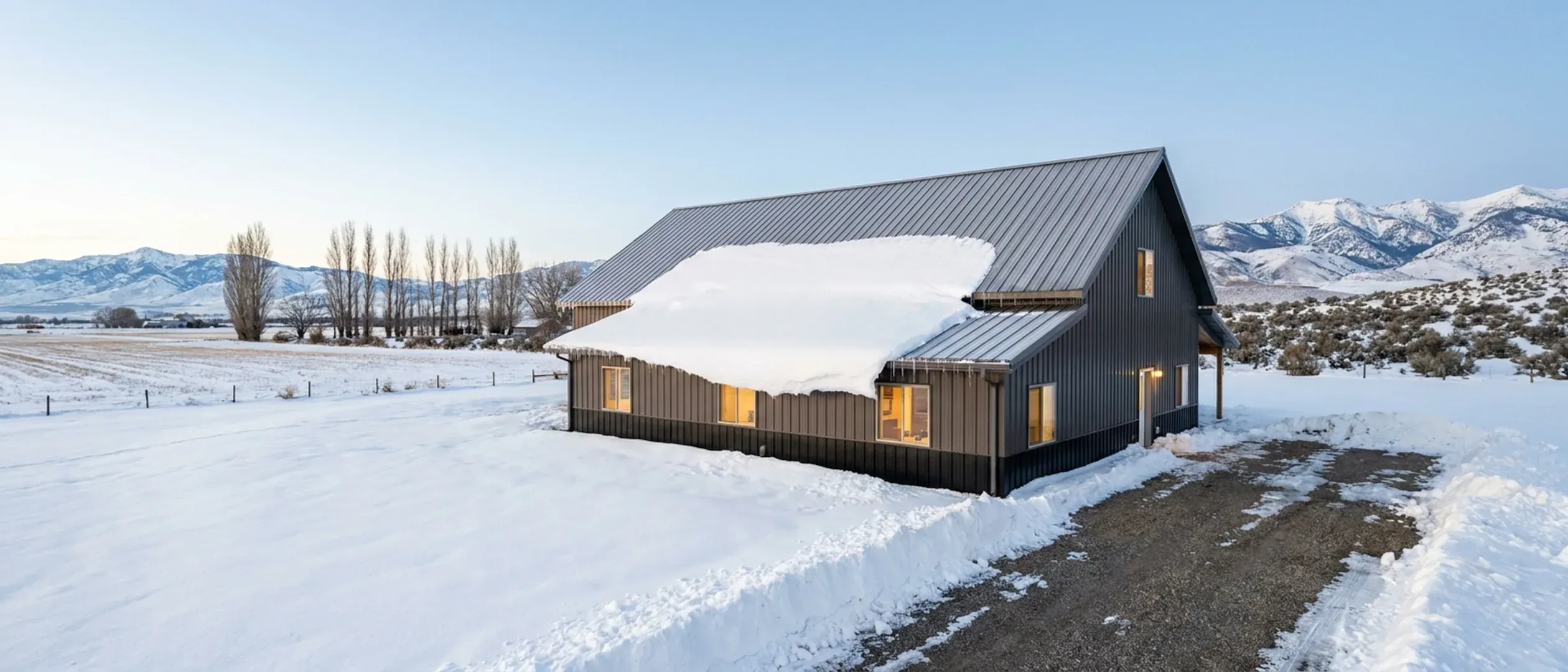
Barndominium Pros and Cons in Idaho: Snow, Cold, Wildfire, Insurance and Appraisal
A barndominium suits a lot of Idaho land: acreage with room for a shop, equipment or animals, and owners who want an open plan under a simple roof. It also meets some specific Idaho conditions. Snow loads range from modest in the Treasure Valley to very heavy in the mountains, and the frame has to be engineered for the load at your lot. Long, cold winters in eastern Idaho make condensation behind metal panels the problem to design out. Wildfire has changed the homeowners insurance market: the Idaho Department of Insurance reports that 12 carriers have sent block non-renewal notices on homeowners policies since the start of 2024. And a rural appraisal depends on comparable sales that can be scarce. None of these rules a barndominium out, but each one is easier to handle before the design is fixed than after. This page sets out the advantages and the drawbacks, with the source behind each Idaho fact.
Figures on this page are cited third-party or government data, not a quote from Idaho Barndominium Builders.
Bottom Line Up Front
- Where a barndominium wins in Idaho: clear-span space, a shop and house under one roof, a metal roof and walls that do not burn, and a building that suits rural acreage.
- Where it is weaker: the frame must be engineered for your lot's snow load, cold winters make condensation control essential, wildfire risk shapes insurance, and rural appraisals can lack comparable sales.
- Most of the drawbacks are handled in design and due diligence: the snow load from the building official or engineer, a vapor and insulation plan for the climate zone, an insurance quote on the actual design, and a lender who has financed one.
Three different buildings, one word
"Barndominium" covers three quite different structures, and many of the pros and cons depend on which one you build.
Pole barn construction
Wood posts set in the ground or on piers, with trusses spanning between them and metal roof and wall panels. Engineers call it post-frame. It is economical for wide spans, and the post embedment and truss design have to suit the site's snow load and frost depth. See pole barn homes.
Steel frame
Engineered steel columns and rafters on a concrete foundation, with metal panels. It suits very wide clear spans and tall shop doors, and the manufacturer's engineering covers the design loads. See steel construction.
Conventional framing with metal cladding
A stick-framed or engineered-wood house with a metal roof and metal siding. It looks like a barndominium and appraises and insures most like a conventional house.
Where a barndominium genuinely wins
These advantages hold across Idaho, and some are stronger here than elsewhere.
Clear span and a floor plan you can change
With the loads carried by the frame, interior walls are often non-structural, which makes large open rooms possible and later changes easier.
Shop and house under one roof
On acreage, a shop for equipment, vehicles or a trade is often the reason to build one. Sharing a roof, foundation and utilities with the house can use less land and less site work than two buildings.
A roof and walls that do not burn
Metal roof and wall panels are noncombustible, which helps on wildfire-exposed land. The rest of the building still matters: vents, eaves, decks, doors and whatever grows or is stored against the walls.
A roof built for snow
A simple roof with no valleys and a smooth metal surface sheds snow readily, provided the frame is engineered for the site's snow load. Plan where sliding snow will land, away from doors, walkways, the driveway and any lower roof.
Suited to the land Idaho has
Idaho law does not treat living space as an agricultural building, so a barndominium is permitted as a house, while a separate barn or shop with no living space can still qualify as one. That lets an owner combine the two, or keep them apart, as the land and budget suit.
Where it is weaker, and what to do about it
Each of these can be managed, but not after the kit is ordered and the foundation poured.
Condensation behind the metal
In a cold climate, warm, humid indoor air that reaches the back of a cold metal panel condenses there. The fix is in the design: continuous insulation and air sealing, a vapor control plan for the climate zone, and ventilation. The Idaho energy code sets the insulation levels for your zone.
Snow load engineering
A frame designed for the Treasure Valley may be under-built for a mountain or high-desert site. Get the design snow load for the lot from the building official or your engineer before ordering, and make sure the manufacturer's engineering matches it.
Appraisal and comparable sales
Where few barndominiums have sold nearby, the appraisal may lean on conventional houses or older sales, and a large shop may add little value in the appraiser's analysis. Talk to a lender and an appraiser who work in the county early. See barndominium financing.
Insurance in wildfire country
With carriers non-renewing homeowners policies and more coverage moving to surplus lines, the design, the site and the defensible space around the building can decide whether a standard policy is available. Get a quote before committing to the site.
The rules depend on the county
Some Idaho counties issue residential building permits and some do not, and zoning, septic and ditch rules decide whether a parcel works at all. See are barndominiums legal in Idaho.
Idaho conditions to plan for
The same building meets different conditions in different parts of the state.
Treasure Valley and Magic Valley
Lighter snow and a long dry season make these the easiest places to build. On irrigated land, canals and ditches carry rights-of-way under Idaho Code §42-1102 and §42-1209 that no structure, fence or landscaping may enter without the ditch owner's written permission.
Eastern Idaho
Cold winters make insulation, air sealing and frost-protected foundations the priorities, and they shorten the building season.
The mountains and central Idaho
Deep snow, heavy snow loads and wildfire exposure together make engineering, roof design and insurance the three things to settle first.
North Idaho
More rain and snow than the south, and wooded land where wildfire and insurance matter. Keep materials dry during construction and plan defensible space around the building.
Reading this because you are weighing a build? The next step is a plan drawn for your program.
What's different about Idaho
Snow loads range widely, and the lot decides
Idaho publishes no statewide snow load. Idaho Code §39-4116 lets local jurisdictions amend the residential code's design criteria, and the common reference is the University of Idaho's Ground Snow Loads for Idaho, 2015 Edition, which says users should verify values with the local authority having jurisdiction, and refers them to the ASCE/SEI 7 standard for roof design loads, including effects such as drifting, sliding snow and rain on snow. Climate records show the range: the Western Regional Climate Center reports about 20 inches of snow a year at Boise Air Terminal and 134 inches at McCall. A kit engineered for one site is not automatically right for another.
Long, cold winters in the east and the mountains
The Western Regional Climate Center's narrative calls eastern Idaho's climate more continental than the west and north. Its record for Idaho Falls Fanning Field shows a January average low of 10.2 degrees and average overnight lows below freezing from October through April. The EPA's moisture-control guidance explains the risk that follows: when humid air contacts a surface that is cold enough, the water vapor in it condenses onto that surface. Inside a heated barndominium, the cold surface is the back of the metal panel, so the insulation and vapor control have to keep warm indoor air away from it.
Wildfire and the insurance market
The Idaho Department of Insurance's December 2025 summary reports more than 200 structures burned in 2024 and about one million acres burned that year, and says 12 carriers submitted block non-renewal notices related to homeowners coverage since the start of 2024. It also reports $168 million in premium paid by Idahoans to surplus lines companies for property coverage in 2024, twice the 2022 amount. On wooded or range land, get an insurance quote on the actual design and site before committing.
Hail and tornadoes are small concerns
The Western Regional Climate Center's narrative says Idaho has an extremely small incidence of tornadoes, that hail damage is very small compared with the central United States, and that hail often does not grow larger than half an inch. Windstorms do some damage to trees each year but only minor damage to structures in most instances. That is good news for a metal roof, though it is no reason to skip the wind design the code requires.
Appraisal on rural land
Fannie Mae's Selling Guide says rural properties often have large lot sizes and may have a shortage, or absence, of recent truly comparable sales nearby. It allows unique and nontraditional housing when the appraiser has adequate information, and says comparable sales need not be of the same design. It also says a large barn or similar outbuilding can indicate a property is agricultural in nature, and that the lender must then decide whether it is residential. A barndominium with a very large shop can raise that question.
The shop and the homeowner's exemption
Idaho Code §63-602G gives a primary residence its owner lives in a homeowner's exemption from part of its property tax, and says the homestead can be part of a multipurpose building but excludes any portion used exclusively for something other than the owner's primary dwelling. A shop used only for a business or for equipment can be assessed differently from the living space. The county assessor applies it.
Pros and cons, honestly
Pros
- Clear-span interiors and a floor plan that can change.
- Shop and house under one roof on rural acreage.
- Noncombustible metal roof and wall panels.
- A simple metal roof that sheds snow when engineered for the site.
- Hail and tornadoes are small risks in Idaho.
Cons
- The frame must be engineered for the lot's snow load, which varies widely.
- Condensation behind metal panels must be designed out in cold winters.
- Wildfire exposure affects insurance availability and price.
- Rural appraisals may lack comparable barndominium sales.
- A shop used only for business or equipment may not share the homeowner's exemption.
Are barndominiums a good idea in Idaho?
Can a barndominium handle Idaho snow?
Do metal barndominiums have condensation problems?
Is a barndominium safer in a wildfire?
Is it hard to insure a barndominium in Idaho?
Do barndominiums appraise well?
Is hail a problem for a metal roof in Idaho?
Pole barn or steel frame for an Idaho barndominium?
Questions answered? Tell us what you want to build and we will put real numbers against it.
Sources
- University of Idaho — Ground and Roof Snow Loads for Idaho
- Idaho Code §39-4116 — Local government adoption and enforcement of building codes
- Western Regional Climate Center — Climate of Idaho
- Western Regional Climate Center — Boise Air Terminal monthly climate summary
- Western Regional Climate Center — Idaho Falls Fanning Field monthly climate summary
- Western Regional Climate Center — McCall monthly climate summary
- U.S. EPA — Moisture Control Guidance for Building Design, Construction and Maintenance
- Idaho Department of Insurance — Wildfires and property insurance (December 2025)
- Fannie Mae Selling Guide — B4-1.3-08, Comparable Sales
- Fannie Mae Selling Guide — B4-1.3-05, Improvements Section of the Appraisal Report
- Idaho Code §63-602G — Homeowner's exemption
- Idaho Code §42-1102 — Right-of-way for ditches and canals
- Idaho Code §42-1209 — Encroachments on irrigation easements and rights-of-way
Keep reading
The pages that answer the next question this one raises.
Are barndominiums worth it in Idaho?
When the shop-plus-house case holds, and when it does not.
Read itAre barndominiums legal in Idaho?
The code, who enforces it, zoning, septic, wells and ditches.
Read itBarndominium build timeline
The stages in order, and the winters to plan around.
Read itPole barn homes
Wood posts, metal skin and wide clear spans.
Read itSteel construction
Engineered steel frames and what to ask the manufacturer.
Read itBarndominium financing
Appraisal and lending on a barndominium.
Read itStart the survey
Tell us about your land and what you want to build.
Read itWant a real number instead of a range?
Start the survey and tell us about your land and what you want to build. Include the county and parcel number if you have them, because in Idaho the zoning, the septic permit, the well and the power line to the site change the budget more than the building does. The survey costs nothing.