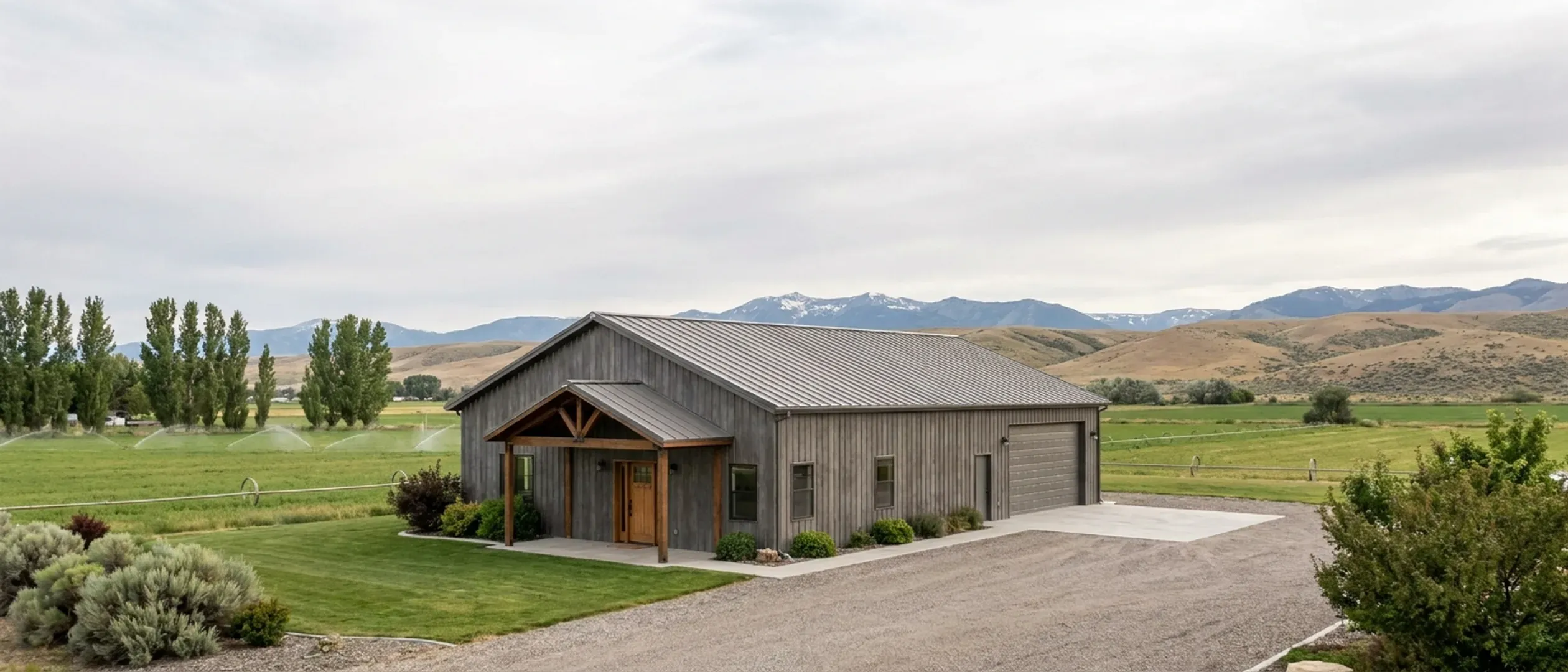
What Size Barndominium Can You Build for Your Budget in Idaho?
"How big a barndominium can I build for $200,000?" has an honest answer, but it comes in two steps. First, take off everything that is not the building: the land, the septic system, the well, the power line and the driveway. On an Idaho acreage those can be a large share of the money. Second, divide what is left by a published cost per square foot for a finished house. The Census Bureau publishes that figure for houses a contractor builds on the owner's land in the West region, which includes Idaho. This guide runs the arithmetic for budgets from $100,000 to $500,000, shows what a small barndominium looks like at the low end, and explains how a shop, a phased finish and a simple plan stretch the footprint. None of the figures is our pricing.
Figures below are industry data from cited third-party sources, not a quote from Idaho Barndominium Builders. Every project is priced individually.
Bottom Line Up Front
- At the Census Bureau's 2025 West figures for contractor-built houses ($176.87 median and $213.85 average per square foot, land excluded), $300,000 of building budget covers roughly 1,403 to 1,696 finished square feet.
- Land and site costs come off the top first. USDA puts 2026 Idaho pasture at $2,500 an acre, Central District Health charges $1,070 for a new septic permit, and Idaho Power's residential line extension allowance is capped at $3,778.
- Small barndominiums are common in the data: 29% of contractor-built houses completed in the West in 2025 were under 1,400 square feet, the Census reports.
Published cost figures
Third-party and government figures, each with its source. None of them is a quote, and none of them is ours.
| Measure | Range | Source |
|---|---|---|
| Contractor-built houses on the owner's land, West region, started in 2025: median to average contract price (land excluded) | $177–$214 per sq ft | U.S. Census Bureau, Characteristics of New Housing 2025, Median and Average Contract Price per Square Foot of New Contractor-Built Single-Family Houses Started: West median $176.87, average $213.85 (read 27 Sep 2026) — https://www.census.gov/construction/chars/xls/contractpricesqft_cust.xls |
What actually moves the number
Land first
USDA's Land Values 2026 Summary puts Idaho pasture at $2,500 an acre, non-irrigated cropland at $2,550 and irrigated cropland at $9,500. Those are farm averages; a small acreage near a Treasure Valley or Eastern Idaho city is priced by its own market. If the land is not yet bought, it is the first line of the budget.
Septic, well and power
The public health district for your county issues the septic permit; Central District Health lists a new permit at $1,070 from July 2026, and the system itself is priced after the site evaluation. A domestic well needs a licensed driller and an IDWR drilling permit, $75 under Idaho Code §42-235, and is priced by the driller once the site is known. Under Idaho Power's Rule H the line extension costs the work order cost less an allowance of up to $3,778 for a residential service.
Driveway and pad
NAHB puts the driveway at 2.3% of construction cost for a typical home and excavation and foundation at 10.0%. A house set back from the road on acreage pays for the distance in gravel, trench and cable.
The finish level
Interior finishes are 24.1% of NAHB's construction cost and the mechanical rough-ins 19.2%. A plain finish schedule stretches the square footage; a custom kitchen and heated floors shrink it.
Step 1: take the land and site costs off the top
Everything below the building is priced for your parcel, so start there.
Land
If you still need land, its price comes out of the budget first. USDA's 2026 Idaho farm averages range from $2,500 an acre for pasture to $9,500 for irrigated cropland, and small acreages near cities sell on their own terms.
Septic and well
Off a city sewer, budget the septic permit from the public health district for your county ($1,070 for a new permit at Central District Health from July 2026) and the system the site evaluation allows. Off a city water line, budget a well: an IDWR drilling permit ($75 for a domestic well under Idaho Code §42-235) and the drilling, pump and pressure system a licensed driller prices.
Power
Ask the utility for a written line extension estimate. Idaho Power's Rule H charges the work order cost less an allowance of up to $3,778 for a residential service, and a company-installed underground service cable costs $14.87 a foot for 1/0 cable.
Driveway, pad and permits
NAHB puts site work, including permit, impact and water and sewer fees, at 7.6% of construction cost and the driveway at 2.3%. On acreage, add a gravel approach and the pad for the building.
Step 2: divide what is left by a published cost per square foot
These rows divide a building budget by the Census 2025 West figures for contractor-built houses on the owner's land: $213.85 average and $176.87 median per square foot, land excluded.
A $100,000 building budget
Roughly 468 to 565 finished square feet at the Census figures. At this level the realistic options are a small one-bedroom plan or a larger shell finished in stages.
A $200,000 building budget
Roughly 935 to 1,131 finished square feet at the Census figures, enough for a compact two-bedroom plan.
A $300,000 building budget
Roughly 1,403 to 1,696 finished square feet at the Census figures, which is a typical three-bedroom range.
A $400,000 building budget
Roughly 1,870 to 2,262 finished square feet at the Census figures.
A $500,000 building budget
Roughly 2,338 to 2,827 finished square feet at the Census figures. The Census reports a 2025 West median of 2,354 square feet for contractor-built houses completed, so this budget buys about a median-sized finished house.
Small Barndominiums: What Fits a Smaller Budget
A small barndominium is not an unusual request. The Census Bureau reports that 29% of contractor-built houses completed in the West in 2025 had under 1,400 square feet of floor area, and another 9% had 1,400 to 1,799.
Under 1,000 square feet
At the Census figures a finished home of 1,000 square feet works out to roughly $177,000 to $214,000, before land and site. A one- or two-bedroom plan with an open living area keeps the plumbing in one wall and the roof simple. See the small barndominium floor plan.
A 30x40 footprint
A 30 by 40 foot building is 1,200 square feet on one floor. Finished throughout, it sits between the $200,000 and $300,000 budget lines at the Census figures. The 30x40 barndominium plan shows how that footprint lays out.
Small living area, bigger shop
Many small barndominiums put a compact home beside a larger shop under one roof. Finish the living area fully and the shop as a shop, and the total footprint can be well above what the living-area arithmetic alone suggests.
The site does not shrink with the house
A small house on acreage still needs the same septic permit, well, power line and driveway as a large one. On a small budget those lines are a larger share of the total, so price them before you settle on a size.
Step 3: stretch the footprint with unfinished space
Price living space and shop space separately
A shop with a concrete floor and a liner panel costs far less per foot than a finished bedroom. Ask every builder for the two areas priced separately.
Finish in phases
Some owners dry in the whole shell and finish part of it first. Lenders who finance construction set their own rules for what must be complete at move-in, so ask before you plan the phases.
Keep the plan simple
A rectangle with one roof line, bathrooms and kitchen back to back and standard door and window sizes costs less than a plan with jogs, dormers and custom openings.
Watch the mechanical systems
NAHB puts the plumbing, electrical and HVAC rough-ins at 19.2% of construction cost. Licensed trade contractors size them for the finished area, and a tall open shop space costs more to heat than its floor area suggests.
Reading this because you are weighing a build? The next step is a plan drawn for your program.
What's different about Idaho
County market matters as much as size
Census permit data for 2025 put the average valuation of a new single-family home at about $216,100 in Canyon County, $310,100 in Ada County and $684,800 in Valley County. The same budget buys a different house in each.
Snow load can change the shell price
A roof designed for a mountain snow load needs a heavier structure than one on the Snake River Plain. The University of Idaho's 2015 Ground Snow Loads for Idaho study is the common reference, but the load for your lot is set by the local building official or your engineer, so price the shell for your parcel before you fix the footprint.
Utility and health district fees are published
The septic permit and the power line are the first site costs you can check before buying land. Central District Health and Idaho Power both publish their schedules; if another health district or utility serves your parcel, ask it for its own.
Irrigated ground costs more
USDA's 2026 averages put Idaho irrigated cropland at $9,500 an acre against $2,550 for non-irrigated. If a parcel's price includes irrigation, you are paying for water as well as land.
Pros and cons, honestly
Pros
- The arithmetic uses a published figure, so you can check any quote against it.
- Shop space finished as a shop stretches the footprint well beyond the finished living area.
- A small barndominium is a common house size: 29% of contractor-built houses completed in the West in 2025 were under 1,400 square feet.
- The first site costs, septic permit and power line allowance, are published by the health district and the utility.
Cons
- On a small budget the land and site can take a large share before any building starts.
- The Census figure is a West region average for conventional houses, not an Idaho barndominium price.
- Snow load and county market move the real figure for your parcel.
- Phased finishing depends on what your lender allows.
How big a barndominium can I build for $200,000 in Idaho?
How big a barndominium can I build for $100,000?
What does a 2,000 square foot barndominium cost in Idaho?
What counts as a small barndominium?
Does a shop count in the square footage?
What should I pay for before the building?
Can I finish the barndominium in stages to fit the budget?
Questions answered? Tell us what you want to build and we will put real numbers against it.
Sources
- U.S. Census Bureau — Median and Average Contract Price per Square Foot of New Contractor-Built Single-Family Houses Started (Characteristics of New Housing, 2025) — West 2025: median $176.87, average $213.85, lot excluded. Read 27 Sep 2026.
- U.S. Census Bureau — Square Feet of Floor Area in New Single-Family Houses Completed: Contractor-Built (Characteristics of New Housing, 2025) — West 2025: 29% under 1,400 sq ft, 9% 1,400 to 1,799; median 2,354 sq ft. Read 27 Sep 2026.
- NAHB — Cost of Constructing a Home 2024 (January 2025) — Construction cost breakdown; national averages only. Read 27 Sep 2026.
- USDA National Agricultural Statistics Service — Land Values 2026 Summary — Idaho 2026: pasture $2,500, non-irrigated cropland $2,550, irrigated $9,500 per acre. Released 31 July 2026.
- U.S. Census Bureau — Building Permits Survey, annual county data 2025 — Canyon, Ada and Valley counties, 1-unit. Read 27 Sep 2026.
- Central District Health — Septic Applications, Fees & Resources — New septic permit $1,070 (July 2026). Read 27 Sep 2026.
- Idaho Power — Rule H, New Service Attachments and Distribution Line Installations or Alterations (tariff) — Residential maximum allowance $3,778; underground service cable $14.87 per foot (1/0, company installed), effective 15 March 2026. Read 27 Sep 2026.
- Idaho Department of Environmental Quality — Septic and Septage — Contact the public health district for the county for site evaluations, permits and inspections. Read 27 Sep 2026.
- Idaho Code §42-235 — well construction permits — IDWR permit before construction; $75 for a domestic well. Read 27 Sep 2026.
- University of Idaho — Ground and Roof Snow Loads for Idaho (2015 Edition) — Released 2015 by the Department of Civil Engineering; final design snow loads rest with the engineer, architect, local building official and/or contractor. Read 27 Sep 2026.
Keep reading
The pages that answer the next question this one raises.
Small Barndominium Floor Plans
Compact layouts for a smaller budget.
Read it30x40 Barndominium Plans
1,200 square feet on one floor, a common small footprint.
Read itHow Much Does a Barndominium Cost in Idaho?
Census cost per square foot, Idaho county permit values, land and site costs.
Read itBarndominium Financing in Idaho
Construction loans, land loans and what a lender needs to see.
Read itBarndominium Kits
A shell kit as the first step of a phased build.
Read itWant a real number instead of a range?
Start the survey and tell us about your land and what you want to build. Include the county and parcel number if you have them, because in Idaho the zoning, the septic permit, the well and the power line to the site change the budget more than the building does. The survey costs nothing.