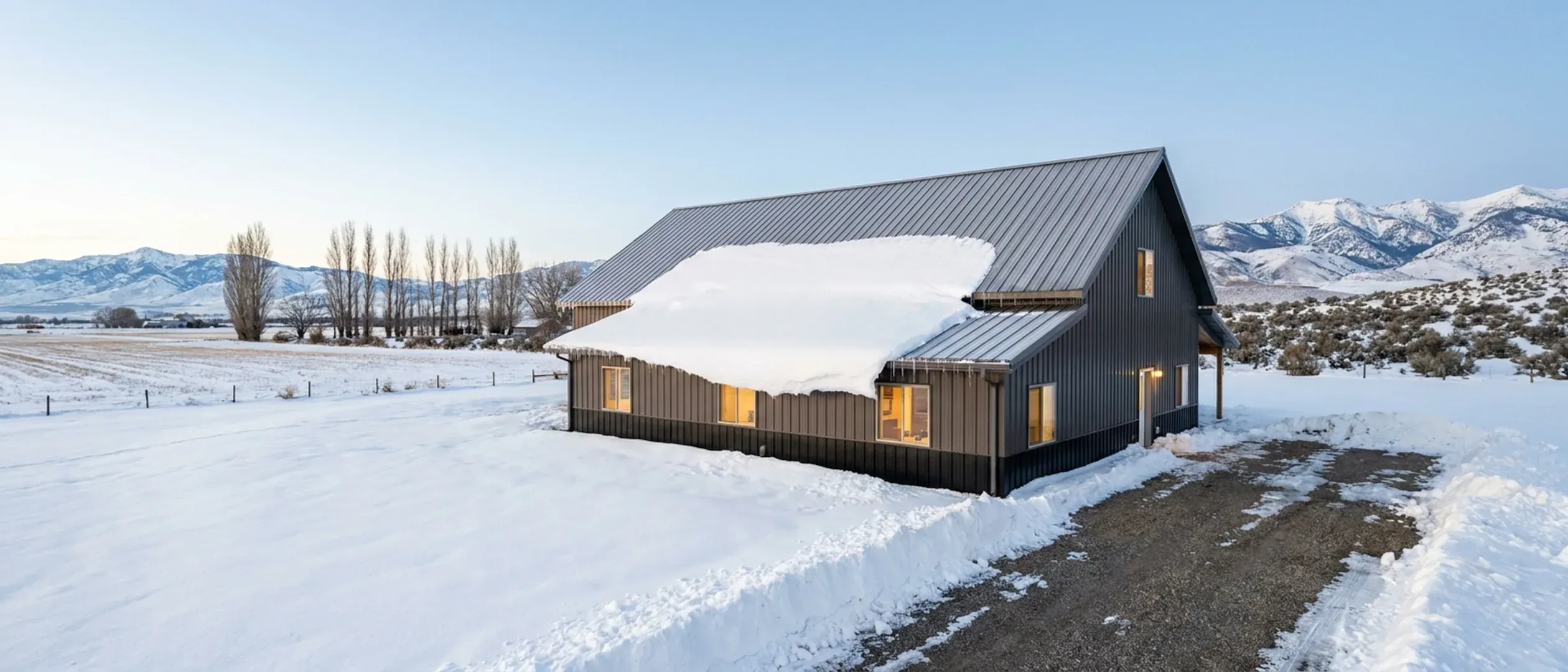
Are Barndominiums Worth It in Idaho? Land, Snow, Insurance, Taxes and Resale
A barndominium is worth it in Idaho when you need what it does well: a shop or equipment space alongside the house, an open plan, and a simple building on rural land. It is less often worth it as a quick investment, or on a parcel where the zoning, the septic answer or the insurance quote is still unknown. Idaho adds its own factors. Snow loads vary from lot to lot, so the frame must be engineered for the site. Wildfire has tightened the homeowners insurance market. The homeowner's exemption covers the home you live in, not a shop used only for business. Sales tax is paid on building materials whoever buys them. And rural appraisals depend on comparable sales that can be scarce. This page does not quote prices of its own; the cost guide covers figures from published sources. It sets out when the case usually holds, when it usually does not, and what to check before deciding.
Figures on this page are cited third-party or government data, not a quote from Idaho Barndominium Builders.
Bottom Line Up Front
- Usually worth it: you need the shop or equipment space anyway, the zoning clearly allows a house, the septic and water answers are known, and you plan to stay for years.
- Usually not: the zoning or septic answer is unknown, you may sell soon, the loan depends on a high appraisal, or the shop is far larger than the property needs.
- Check before deciding: the county zoning and building-permit answer, a septic site evaluation, the snow load for the lot, an insurance quote on the actual design, and a lender that has financed one.
When a barndominium is usually worth it
The case is strongest when the building answers a need you already have.
You need the shop anyway
Equipment, vehicles, animals, a trade or a hobby that needs a large, tall space. Putting it under the same roof as the house shares the foundation, roof and utilities.
The land already allows a house
The zone allows a dwelling, the septic site evaluation has passed and the water supply is known. The remaining questions are then about the building.
You want an open plan that can change
Clear spans leave interior walls free to move as needs change.
You are staying a long time
A long stay lets you use the shop and the space for years and reduces the weight of a cautious appraisal at resale.
The site suits the building
A moderate snow load, low wildfire exposure and room to site the building clear of ditches and easements all make the numbers easier.
When it usually is not
These are the situations where a conventional house, or a house plus a separate shop, often makes more sense.
The zoning or septic answer is unknown
Buying land first and hoping a house will be allowed, or that the soil will take a septic system, is the most expensive way to find out.
You may sell within a few years
Where comparable sales are scarce, resale value is harder to predict, and a short stay leaves less time to recover the difference.
The loan depends on a high appraisal
If the financing only works with a strong appraisal, a building type with few local comparables is a risk. Talk to a lender first. See barndominium financing.
The shop is much bigger than the property needs
A very large shop may add little appraised value, may raise the question of whether the property is agricultural, and may not share the homeowner's exemption.
The site is hard to insure
On wildfire-exposed land where standard carriers decline coverage, the insurance cost can change the whole comparison.
What to check before deciding
All of these can be answered before money goes into land, a kit or a design.
The zoning and building-permit answer, in writing
Ask the county planning and zoning office, or the city inside city limits, whether a house is allowed and whether it issues residential building permits.
The septic and water answer
A site evaluation from the public health district for the county, and a look at nearby well records with the Idaho Department of Water Resources.
The snow load for the lot
From the building official or your engineer. Compare kit quotes only when each is engineered for that load.
An insurance quote on the actual design
Before buying wooded or range land, get a quote for the building you plan, at that site.
A lender that has financed one
Ask how the appraisal will be approached and how a large shop will be treated.
The county assessor's view of the shop
Ask how a combined house and shop is assessed and how the homeowner's exemption applies.
Reading this because you are weighing a build? The next step is a plan drawn for your program.
What's different about Idaho
The land decides first
Idaho's Local Land Use Planning Act requires each city and county to adopt zoning, so the first question is whether a house is allowed on the parcel at all. The next is whether the county, or the city, issues residential building permits; Idaho Code §39-4116 lets local governments choose whether to run a building program. A barndominium is worth building only on land where both answers, and the septic and water answers, are clear. The legal guide explains each layer.
Snow loads change the frame, and the budget
Idaho sets no statewide snow load. The University of Idaho's Ground Snow Loads for Idaho study is the common reference, and it tells users to verify values with the local authority having jurisdiction. The Western Regional Climate Center records about 20 inches of snow a year at Boise Air Terminal and 134 inches at McCall. A heavier design load means a heavier frame and roof, so the same floor plan can cost more to build in the mountains than in the valley. Get the figure for the lot before comparing kit quotes.
Wildfire is priced by the insurer
The Idaho Department of Insurance's December 2025 summary reports that 12 carriers submitted block non-renewal notices on homeowners coverage since the start of 2024, and that Idahoans paid $168 million in premium to surplus lines companies for property coverage in 2024, twice the 2022 amount. On wooded or range land, a quote on the actual design and site belongs in the decision, not after it.
The homeowner's exemption and the shop
Idaho Code §63-602G exempts part of the assessed value of a primary residence its owner lives in from property tax. The homestead can be part of a multipurpose building, but the exemption excludes any portion used exclusively for something other than the owner's primary dwelling. A shop used only for a business or for equipment may not share the exemption. Ask the county assessor how it treats a combined building.
Sales tax on materials is paid either way
Under the Idaho State Tax Commission's rule, IDAPA 35.01.02.012, contractors are the consumers of the goods they use and pay tax on building materials, equipment, tools and supplies. The same rule says that when a project owner buys materials and hires a contractor to install them, tax is due when the owner buys them. Buying the kit yourself does not avoid sales tax; it moves who pays it.
Appraisal on acreage
Fannie Mae's Selling Guide says rural properties often have large lot sizes and may lack recent truly comparable sales nearby, and allows older or more distant sales with an explanation. It accepts unique housing when the appraiser has adequate information, but says large barns and similar outbuildings can suggest a property is agricultural, which the lender must then assess. A shop far larger than the house can add little appraised value.
Pros and cons, honestly
Pros
- Shop and house under one roof share a foundation, roof and utilities.
- Open, clear-span interiors that can change over time.
- Well suited to rural acreage where the zoning allows a house.
- Noncombustible metal roof and walls on wildfire-exposed land.
- The homeowner's exemption applies to the living space of a primary residence.
Cons
- Heavier snow loads mean a heavier, costlier frame in the mountains.
- Insurance is harder to place on some wildfire-exposed sites.
- Rural appraisals may lack comparable sales, and a big shop may add little value.
- A shop used only for business may not share the homeowner's exemption.
- Buying the kit yourself does not avoid sales tax on materials.
Are barndominiums worth it in Idaho?
Is a barndominium cheaper than a house in Idaho?
Do barndominiums hold their value in Idaho?
Does the homeowner's exemption cover a barndominium?
Can I save sales tax by buying the kit myself?
Is insurance a problem for barndominiums in Idaho?
Does snow make a barndominium more expensive in Idaho?
What should I check before buying land for a barndominium?
Questions answered? Tell us what you want to build and we will put real numbers against it.
Sources
- Idaho Code §39-4116 — Local government adoption and enforcement of building codes
- Idaho Code §67-6511 — Zoning ordinance
- University of Idaho — Ground and Roof Snow Loads for Idaho
- Western Regional Climate Center — Boise Air Terminal monthly climate summary
- Western Regional Climate Center — McCall monthly climate summary
- Idaho Department of Insurance — Wildfires and property insurance (December 2025)
- Idaho Code §63-602G — Homeowner's exemption
- IDAPA 35.01.02 — Idaho Sales and Use Tax Administrative Rules (Section 012, contractors improving real property)
- Fannie Mae Selling Guide — B4-1.3-08, Comparable Sales
- Fannie Mae Selling Guide — B4-1.3-05, Improvements Section of the Appraisal Report
- IDAPA 58.01.03 — Individual/Subsurface Sewage Disposal Rules
- Idaho Department of Environmental Quality — Septic and Septage
Keep reading
The pages that answer the next question this one raises.
Barndominium pros and cons in Idaho
Snow, cold, wildfire, insurance and appraisal.
Read itAre barndominiums legal in Idaho?
The code, who enforces it, zoning, septic, wells and ditches.
Read itBarndominium cost
Figures from published sources and what drives them.
Read itBarndominium financing
Loans, appraisal and lenders.
Read itBarndominium kits
Kit packages and what they include.
Read itStart the survey
Tell us about your land and what you want to build.
Read itWant a real number instead of a range?
Start the survey and tell us about your land and what you want to build. Include the county and parcel number if you have them, because in Idaho the zoning, the septic permit, the well and the power line to the site change the budget more than the building does. The survey costs nothing.